



















By Darpan Harar and Justin Jewell, Ninety One
Over recent months, one headline after another has shone a spotlight on risk in the US private credit market.
Issues that have been building for years, relating to the financing of high risk borrowers and a weakening of credit standards, are coming to a head. Scrutiny of the private credit market is increasing and sparking a sell-off in mainstream public credit markets, such as US high yield debt.
Private credit has invested heavily into software and IT, while high yield exposure has remained low.
Private Credit and High Yield exposure to Software and IT sectors
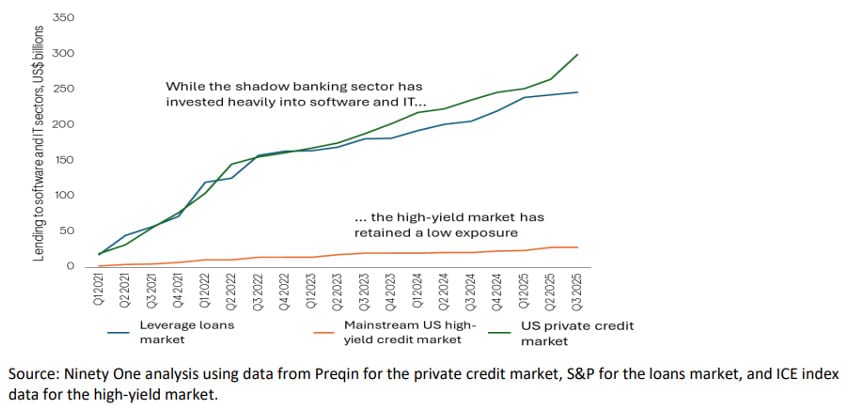
Many loans made post GFC are now under pressure from higher interest rates and AI disruption risk – especially since private lenders invested heavily in the software and IT sectors, areas considered most vulnerable to disruption.
However, recent market moves mask a more nuanced backdrop. With private markets and leveraged loans now dominating the riskier end of lending activity, credit risk in the mainstream high yield market has remained remarkably stable. In fact, the average credit quality of the high yield index is the highest it has been in several decades.
While some segments of the public market have indirect exposure to this theme – notably parts of the insurance and banking sectors, and select business development company (BDC) bonds – we believe many of these structures will prove resilient, supported by strong capitalisation and conservative leverage metrics. As always, selectivity remains key.
Conclusion
The credit landscape is shifting as risks that built up post the Global Financial Crisis begin to surface, particularly in US private markets. In tandem, there’s been a quiet revolution in the high yield credit market – where overall credit quality has improved.
Recent market moves miss this nuance and mask a divergent picture of risk exposure across mainstream credit markets.
By avoiding the most vulnerable sectors and targeting well-structured, higher quality assets, bottom-up investors can navigate the risks while taking advantage of attractive valuations to capture return opportunities.