



















By Global Citizen Solutions
The global wealth management landscape is undergoing a number of alterations. Drawing on insights from thousands of High Net Worth Individuals (HNWIs) worldwide, a report by Capgemini states that traditional investment approaches are increasingly “no longer sufficient” to address the evolving priorities, risk perceptions, and behavioral patterns of HNWIs. It emphasizes the need for new strategies, greater personalization, and more dynamic capital deployment frameworks (CapGemini, 2025).
Therefore, the distinction between traditional and alternative assets matters less as a technical classification than a strategic one.
- Traditional assets, primarily public equities, fixed income, and cash equivalents, remain the core liquid building blocks of most portfolios. Their advantages lie in transparency, liquidity, regulatory oversight, and ease of valuation. Yet in a market environment shaped by inflation shocks, compressed bond returns, and elevated publicmarket correlations, these instruments no longer provide the same diversification and income characteristics they once did. These instruments are highly regulated, relatively liquid, and traded on organized public markets, with transparent pricing and extensive historical data (Doshi, 2023).
- Alternative assets are most simply defined by exclusion: any investment that differs from a traditional stock, bond, or cash deposit. This spans a wide range – real estate, private equity, hedge funds, commodities, infrastructure, managed futures, and structured products, as well as newer categories like cryptocurrencies, NFTs, fine art, wine, and collectibles, which tend to have low correlation with conventional financial markets (Fraser-Sampson, 2012).
The vulnerabilities that affect traditional asset portfolios explain the growing strategic role of alternative assets.
Rather than serving as peripheral holdings, alternatives are increasingly used to access sources of return and resilience that are less available in public markets.
Private equity offers exposure to growth before public listing and the possibility of capturing illiquidity premia. Real assets such as infrastructure, commodities, and real estate can strengthen inflation hedging and diversify return drivers. Private credit has gained relevance as investors seek enhanced yield and stronger covenant structures in a higher-rate environment. Hedge funds and other non-traditional strategies may also help reduce dependence on broad market direction by introducing differentiated sources of risk and return. Alternative portfolios respond better to structural weaknesses of mainstream investment options.
This chart shows a summary of Traditional vs. Alternative investment options and their main characteristics.
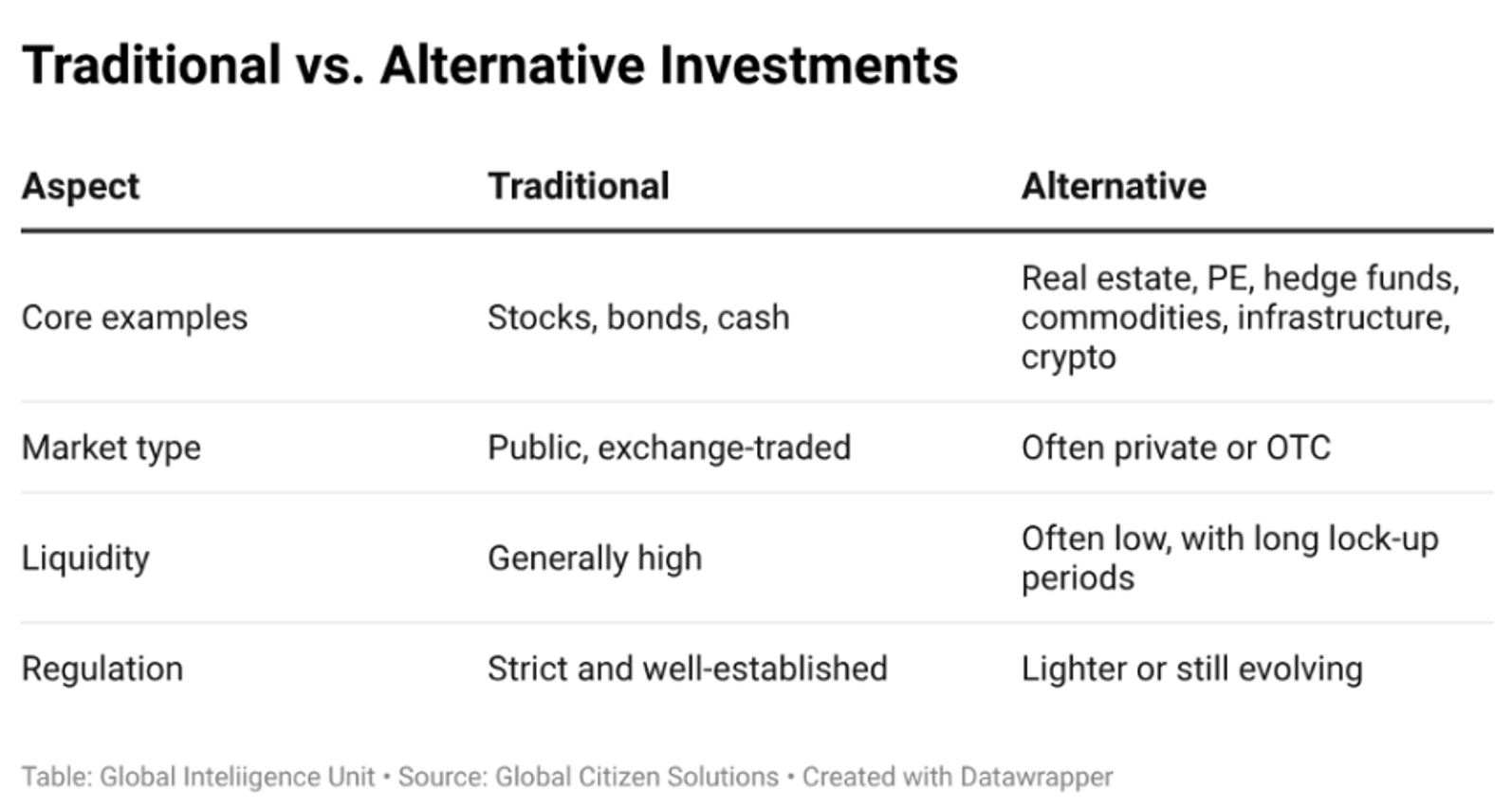
The key difference is that alternative investments offer higher potential returns but carry greater risk and lower liquidity, while traditional investments tend to be safer with more predictable, if modest, returns. In this context, risk primarily reflects liquidity constraints, valuation uncertainty, and lower levels of transparency.
Unlike publicly traded equities and bonds, many alternative assets are privately negotiated and traded in less regulated markets, making it more difficult to price and exit. Consequently, investors require a higher expected return as compensation for bearing these additional risks.