

















No one knows how the Middle East conflict will evolve. I’m reminded of the Talking Heads song, ‘Road to Nowhere’. There are multiple possible outcomes, and day-to-day sentiment changes. This week, US and Australian 10-year government bond yields have rallied as growth concerns dominated market attitude. The US 10Y was down to 4.3%, while the Australian 10Y finished at 4.94%, from a high 5.1%.
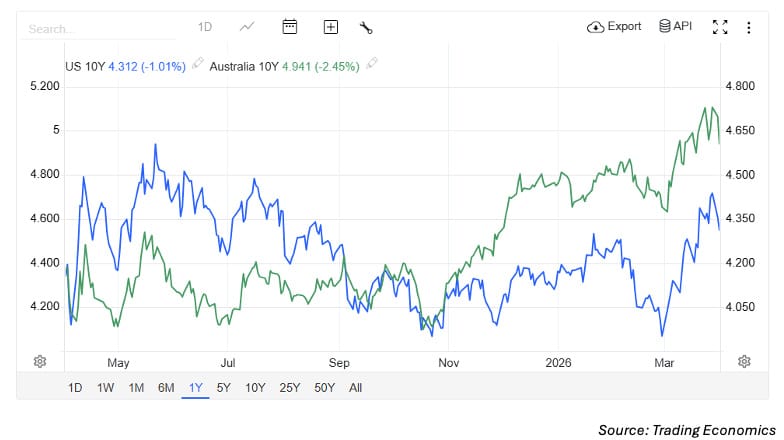
Significantly lower growth would put interest rate cuts back on the agenda. But the path remains unclear.
This uncertainty was reflected in the RBA Monetary Policy Board Minutes where the board was split 5-4 to increase the cash rate last month. The four doves were more cautious on timing, preferring to wait and see what happened with economic growth and consumption rather than being against the rate hike.
Interestingly, all four major bank economists now expect another hike in May.
There’s little question that inflation will rise with ongoing Middle East turmoil and consumer spending should slow. But will it be enough to tip us into a recession? Time will tell.
The range of possible outcomes in the Middle East conflict was covered in these articles:
- According to Greg Peters from PGIM, ‘Investments closer to the front end are more connected to central bank policy and measurable data. Further out the curve, term premia and other hard-to-control factors dominate’. I really liked Peters’ key take away, ‘…isn’t to run and hide but rather avoid overpaying for risk’.
- ‘Treat liquidity like an asset’ was a point made by PIMCO’s Tiffany Wilding and Andrew Balls that resonated.
- Chris Iggo from BNP Paribas points to patience and defensiveness. Iggo covers both equity and bond markets in this article
Ways to protect and diversify differed between the above three articles.
Benoit Anne from MFS Investment Management looked critically at a wide range of fixed income assets and movements since the crisis began. He suggests thinking about break-even yields and the cushions an asset class has before a rise in yield wipes out any positive return.
I was pleased to see Betashares and Coolabah Capital make changes to the HBRD ETF this week. Starting today, the fund will be called the Betashares Australian Credit Income Active ETF and have a different benchmark, amongst other changes.
One last point, data centre operator NextDC was in the market with a new $500m bond deal but pulled the issue due to unfavourable pricing. According to the AFR, investors sought a 375 basis point margin over swap, meaning borrowing costs of 8.5%, deemed too expensive for the company. NextDC has a range of options to raise capital. One is to work towards a credit rating, which would likely lower borrowing costs. Others include restructuring the issue to include a debt-for-equity clause or simply to wait until markets settle.
Have a great week!