














The Middle East conflict and oil supply shock continue, contributing to higher inflation. There’s no end in sight even if the conflict is resolved soon, it’ll take time to rebuild infrastructure and get oil flowing through the Strait of Hormuz.
Compounding global inflation is fiscal spending. Developed countries with high debt-to-GDP ratios are walking a fine line. Governments can take on more debt to support their economies but risk longer term investors demanding higher compensation, leading to greater interest costs and higher debt.
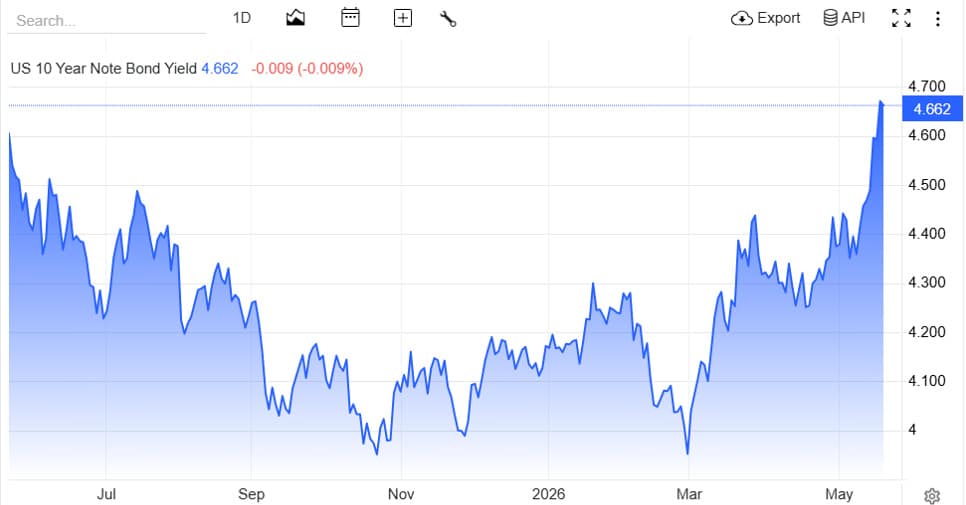
We’ve begun to see steep rises in many developed country bond yields. The US 10-year bond yield is now sitting at 4.66%, up 30 basis points since 8 May.
Laura Cooper from Nuveen explains the predicament in an excellent article, ‘Is the Bond Market Repricing the Wrong Risk?’
Agility and diversification are key to investing in this market, says Capital Group after they surveyed 300 senior investment professionals from institutional asset owners across Asia-Pacific (APAC), Europe and the Middle East (EMEA) and North America. This is a very interesting analysis of fixed income investment intentions for the next 12-24 months.
Investors need to dig deeper and understand country-level drivers rather than rely on broad regional exposures, says Escala. Understanding geographic exposure can improve portfolio construction and better help investors assess diversification, risks, and opportunities.
Finally, Bloomberg has announced it now offers Exchange-For-Physical trading in the Australian market. This allows investors to link a bond trade and corresponding future in a single trade.
In Australian corporate bond market news:
- Barclays has launched an Australian dollar additional Tier 1 deal with a fixed-to-reset coupon at 8.25%
- BNG Bank has launched a five-year senior unsecured sustainability Kangaroo bond. The bond is fixed rate with an indicative 5.164% indicative yield
- BPCE has launched a multi-tranche Kangaroo:
- A five-year senior fixed and/ or floating rate note with price guidance of 115 basis points over swap, expected issuer A+ rating
- A 15-year non-call 10 (15NC10) local economic development social tranche, fixed to floating with an expected BBB rating at 225 basis points over semi quarterly swap
- CaxiaBank has raised $1 billion in a dual tranche Kangaroo:
- $400m in a fixed tranche with a 5.801% coupon
- $600m in a floating rate tranche at 107 basis points over 3-month BBSW
- HSBC has priced a $1.4 billion multi-tranche Kangaroo deal:
- $550m 6NC5 floating rate note with a coupon of 125 basis points over 3-month BBSW
- $550m 6NC5 fixed to floating rate note with a coupon of 5.996%
- $400m subordinated 11NC10 fixed to floating at 6.597%
- Metropolitan Life Global Funding (Metlife) has mandated a five and ten-year tranche deal
- SA Power Networks has raised $300m in a five-year fixed-rate senior unsecured green bond with a coupon of 5.682%
- Registry Finance has priced a $600m multi-tranche deal:
- $350m for six years with a 5.84% issue yield
- $250m for 10 years at 6.327%
- Unity Bank has priced a $100m three-year floating rate note priced at 120 basis points over 3-month BBSW
- Vonovia SE has priced a $300m senior unsecured seven-year fixed-rate benchmark Kangaroo with a 6.385% coupon.
Have a great week.