



















Interest in ETFs is hitting all-time highs following record inflows so far this year. VanEck, the pioneer of smart beta strategies* in Australia, has found that financial advisers are increasingly using ETFs, and that smart beta strategies are gaining further momentum this year, according to its 2026 Smart Beta Survey, the world’s largest survey of its kind.
Over the past year 73 per cent of financial advisers have increased their usage of ETFs. The top three drivers for investing in ETFs were reduced total portfolio costs (49 per cent), a change in portfolio strategy (42 per cent) and long-term active manager underperformance at 33 per cent.
Smart beta is the term given to ETFs which track an index that differs from the traditional market capitalisation approach of selecting shares, bonds or other assets. That is, smart beta ETFs take a “smarter” and more considered approach to what goes into the fund other than just the size of the company. The smarter approach may be based on one or more predetermined factors or investment methodologies. For example equal weighting, capping, factor/multifactor based or fundamentally weighted.
Smart beta index strategies, which are the intersection between market cap and active strategies, have also seen a pickup in usage since 2025. Overall, around 80 per cent of respondents are using one or more smart beta ETFs, up from 72 per cent in 2025. The use of 2 or more smart beta ETFs increased from 2025 to 2026 by 15 per cent, with fewer respondents using only one or none.
These strategies are also increasingly being used to replace market cap and active strategies, with 50 per cent of respondents using these strategies to replace market cap (on par with 2025), and more using smart beta strategies to replace active strategies (64 per cent up from 61 per cent in 2025).
Half of the respondents are also looking to increase allocations to smart beta strategies over the next 12 months and 77 per cent of respondents agree that smart beta strategies will become more prevalent in portfolios. A total of 80 per cent of respondents noted these strategies represent good value for money, an increase from 74 per cent in 2025.
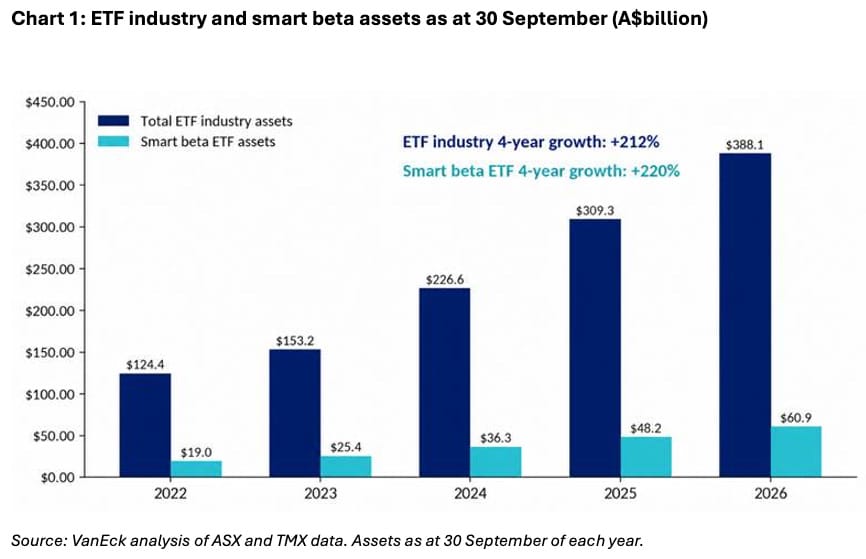
Investments in ETFs are nearing the forecast $400 billion mark with $6.92 billion of inflows in the month of September. According to VanEck CEO and Managing Director, Arian Neiron, the allocation of flows reflects how investors are reading the market.
“Allocation to ETFs reached $388.1 billion across 507 products at the end of September. This is more than six times the value of all listed investment companies and trusts,” said Neiron.
Where September’s $6.29 billion went
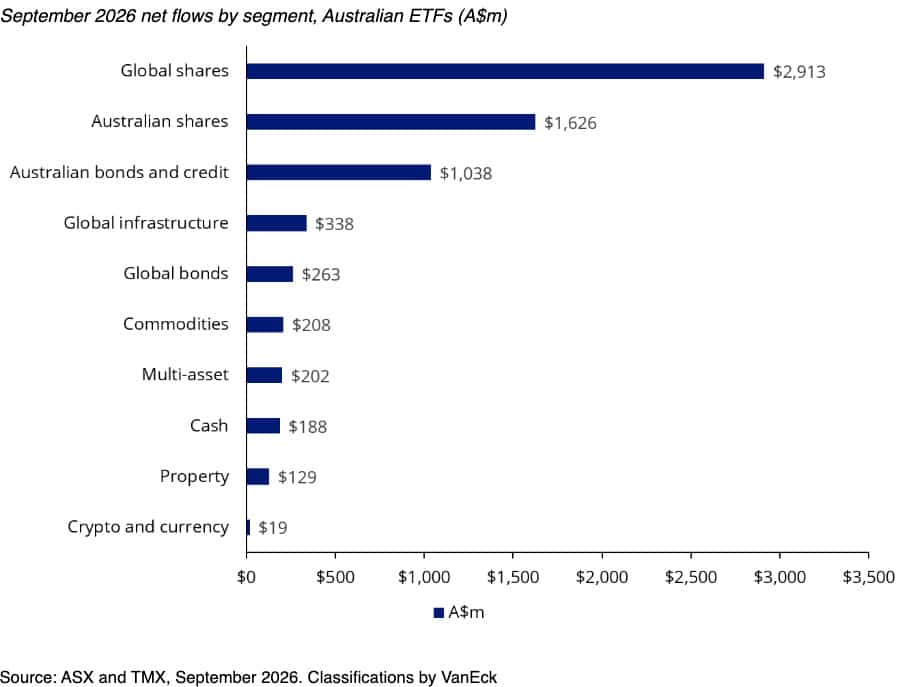
“The allocation of September flows tells an interesting story. Despite the Australian share market falling 2.6 per cent in September Australian investors added $1.63 billion to Australian equities, equivalent to 23.5 per cent of total ETF flows. What it suggests is that investors took advantage of this fall to add further exposure to the Australian market as opposed to following parts of the international market that had risen.
Australian shares took less weight; income assets took more
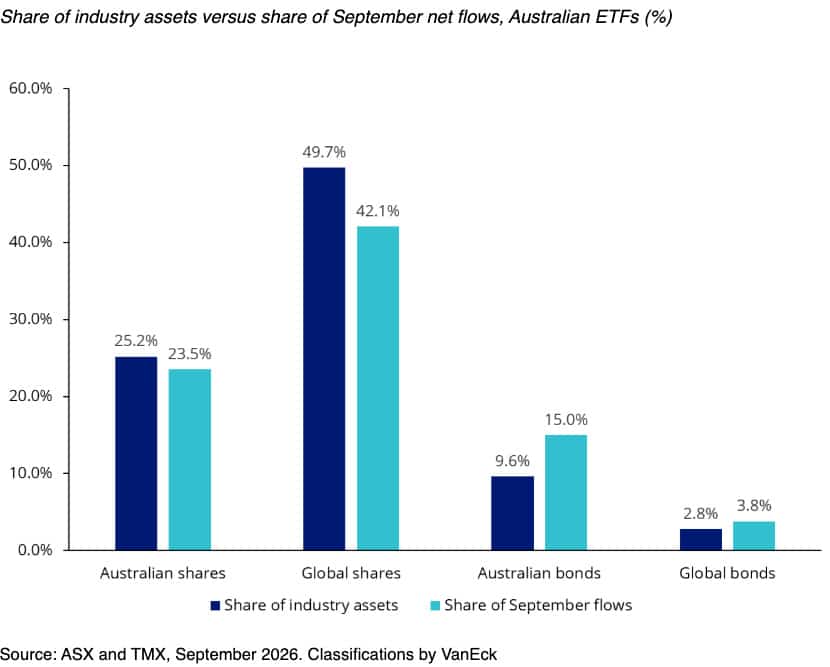
“Defensive assets, including cash saw an uptake with $1.49 billion in flows. Of that $1.30 billion, representing 18.8 per cent of total ETF flows was allocated to fixed income strategies. Income strategies that move with interest rates including floating rate, subordinated debt and hybrids saw the largest allocations in that asset class.
“What we take away from this data is that bond investors are selective rather than simply being defensive. They are looking for income that keeps pace with interest rates and protects against inflation, and ETFs give them the ability to gain exposure to both.”
Arian Neiron said the ETF industry was entering its next phase of growth, with smart beta ETFs set to play an increasingly dominating role in the Australian investment landscape and the construction of investment portfolios.
“Advisers and investors are looking for more cost-effective and tax-efficient ways to invest. The shift from traditional unlisted managed funds towards managed accounts is accelerating, and ETFs are a key beneficiary,” Neiron said.
“The active versus passive debate is gathering pace, especially with active management strategies being challenged with underperformance for some time. More advisers are turning to systematic ETF strategies to target investment outcomes at a lower cost.
“One of the clearest shifts over the past few years has been the growing use of smart beta as a core portfolio allocation. Smart beta net flows have grown every quarter this year, from $2.38 billion in the first quarter to a record $3.66 billion in the third.
“Now accounting for close to 16 per cent of total industry assets, we think the current $60.9 billion allocated to smart beta index strategies will surpass $100 billion during 2028. The next 25 years won’t be defined by more ETFs, rather by smarter ETFs that investors and advisers can use to build well-diversified investment portfolios.”