


















Australia’s deteriorating employment market has given fixed income investors a compelling reason to reconsider one of the most successful investment strategies of recent years: holding cash and waiting.
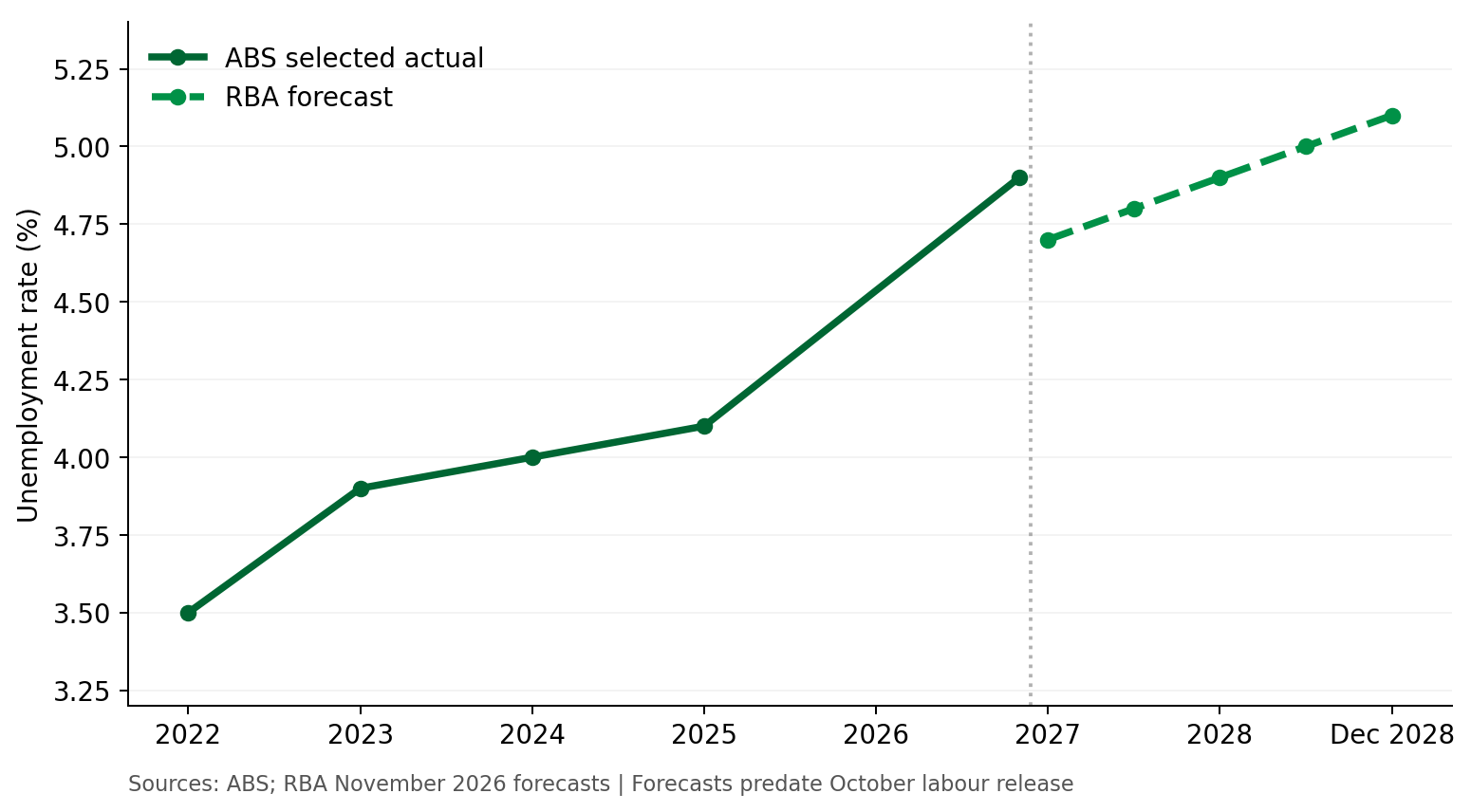
The Australian Bureau of Statistics reported that unemployment climbed to 4.9% in October, its highest level since 2021. Employment fell by 43,500 people during the month, while the number of unemployed Australians increased by 17,800.
For investors, these numbers raise an important question. Has the balance of risk shifted far enough to justify moving some capital out of cash and into fixed-rate bonds? The answer is becoming more interesting, although the case for immediate rate cuts remains far from settled.
The Reserve Bank increased its cash rate to 4.85% in November as it continued fighting inflation. Its latest forecasts suggest underlying inflation will remain above 3% until late 2027, with the unemployment rate potentially reaching 5.1% by the end of 2028.
CHART 1: Unemployment history and RBA Outlook
That creates an uncomfortable combination of weakening employment and persistent inflation. It also increases the importance of how investors position their fixed income portfolios.
For much of the tightening cycle, cash, term deposits and floating-rate securities offered an attractive combination of income and capital stability. Investors could earn relatively high yields without accepting the price volatility associated with longer-duration bonds. But the attraction of cash changes when interest rates start falling.
Cash and floating-rate investments reprice relatively quickly, reducing the income available to investors. Fixed-rate bonds, by contrast, can preserve their contractual coupon payments and potentially deliver capital gains as market yields decline.
The distinction matters because bond markets generally anticipate monetary policy changes well before central banks announce them. Investors who wait for the first RBA cut could discover that much of the potential capital appreciation has already occurred.
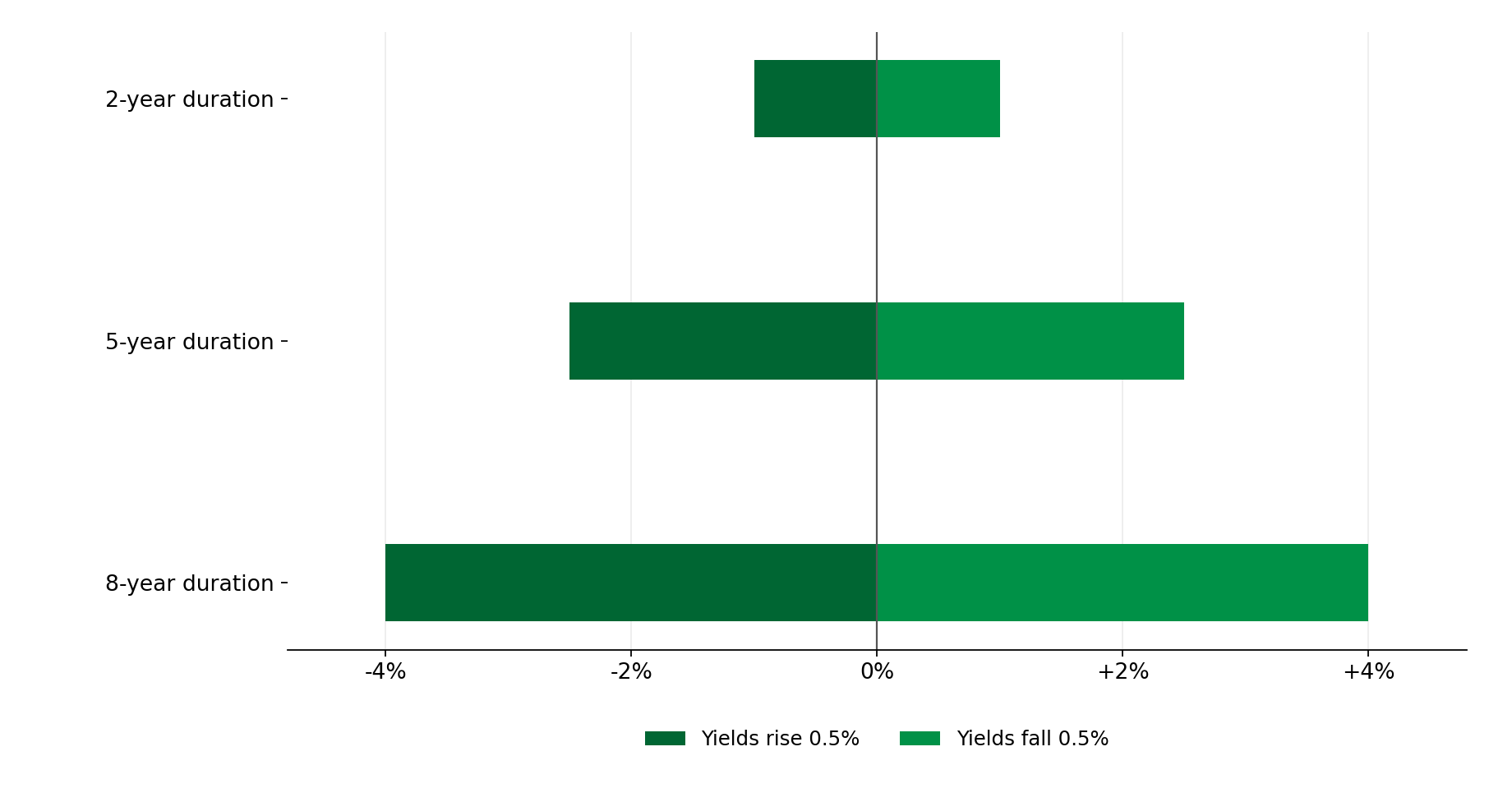
Consider a bond portfolio with an effective duration of five years. A 0.5 percentage point decline in market yields would produce an approximate 2.5% capital gain, before allowing for coupon income, convexity and other market movements. A comparable portfolio with a duration of two years would gain approximately 1%.
The reverse also applies. If inflation proves more persistent and yields rise, longer-duration investors face greater capital losses. This is why the decision should not be framed as abandoning cash entirely.
A more measured approach would involve gradually extending duration, particularly through high-quality government bonds and investment-grade corporate securities.
CHART 2: Bond price sensitivity to a .5% yield move
Australian government bonds offer relatively strong protection against credit deterioration and can benefit when economic growth weakens. Investment-grade corporate bonds offer additional yield, but investors must assess whether that premium adequately compensates for credit risk.
Rising unemployment can eventually translate into weaker corporate earnings, higher defaults and widening credit spreads. Those developments could offset some of the benefits of falling government bond yields.
Term deposits also deserve consideration. They allow investors to lock in an interest rate for a defined period without daily market-price fluctuations, although early withdrawal restrictions and reinvestment risk remain important.
Floating-rate notes should not be dismissed either. They provide protection if inflation forces the RBA to keep rates elevated, or increase them further. The opportunity cost of waiting is therefore not guaranteed and it depends on how quickly inflation moderates, how far unemployment rises and whether bond markets have already priced in future easing.
For investors, the most sensible response may be to build a portfolio capable of benefiting from falling rates without relying entirely on that outcome. A combination of cash for liquidity, shorter-dated securities for stability and intermediate-duration bonds for potential capital appreciation offers one way to manage the transition.
Australia’s employment figures have not guaranteed the next move in interest rates. But they have challenged the assumption that cash will remain the most attractive defensive investment indefinitely.
The question for fixed income investors is no longer simply how much income their portfolios generate today. It is how much of that income they can preserve, and what total return they might achieve, when the interest rate cycle eventually turns.