

















At Fixed Income News Australia, we want to give you access to the best global commentators, and this week I’m proud to showcase an article we published late last week by Arif Husain, who is Head of Global Fixed Income at T. Rowe Price. Husain predicted a steep rise in government bond yields, and less than a week later, global government bond yields leapt. While the moves are significant, Husain believes they have further to go. This is an important article for any investor.
Developed nations are living off debt and seem unwilling to cut spending to bring down deficits. So, when Trump announced unexpected new tariffs for Europe and Japan is proposing cuts to a food sales tax could worsen the country’s debt burden – global government bonds sold off yesterday, and yields rose.
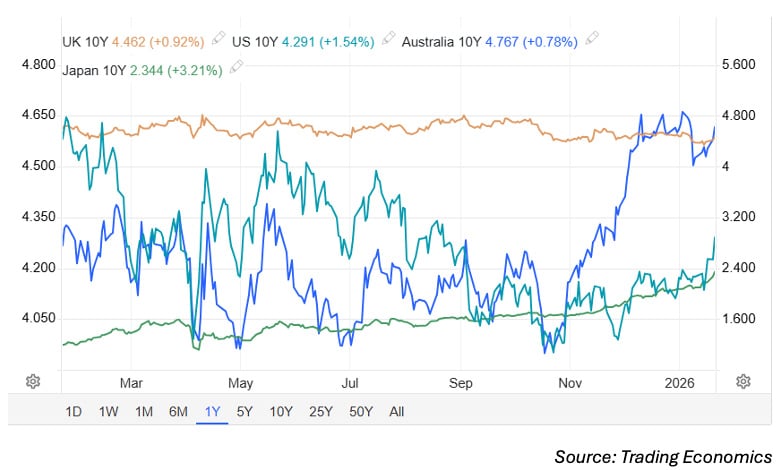
The US 10-year leapt around 7 basis points yesterday to reach 4.29%, the highest level since August, as shown by the teal line in the graph below. The Japanese 10-year was also up 7 basis points to 2.32%, to a high last seen in 1999. Over the last 12 months, the Japanese 10-year has risen from 1.82% to 2.34%, while the UK 10-year has had the highest consistent rate and is the only one of the four countries shown in the chart to have seen the 10-year rate virtually unchanged in the last 12 months to finish at 4.46%. Note Japan is represented by the dark green line and the right hand side axis, while the UK is shown in orange.
At home, the 10-year is significantly higher thanks to a high inflation print late last year and expected rate hikes in 2026. Still, the 10-year rate climbed yesterday in uncertain times to finish at 4.77%.
I agree with Arif Husain and think longer term government bond yields will continue to rise as investors worry that there’s no end in sight for mounting debt.
Government bond yields are used as benchmarks for practically all other asset classes. If yields move higher, so too should yields on other assets.
While we’re talking about rates, the US looks set to continue its easing cycle according to Robert Tipp at PGIM towards a sub-neutral range by 2H26. Low rates should stimulate growth and debt, and it makes me wonder if we’ve beaten inflation.
Short-term government bonds and short-term high-grade corporate bonds make sense in a highly uncertain market.
A new US Fed chair may add to global rate volatility, according to Thomas Poullaouec at T. Rowe Price in his popular monthly global asset allocation notes.
Philip Brown from FIIG Securities suggests ways to manage your portfolio when interest rates are rising and suggests some longer-dated, callable bonds with 6% plus returns.
Finally, we have a terrific educational article from Robert Almeida from MFS Investment Management, comparing cyclical booming companies and compounders.
Have a great week!