


















Key Insights:
-
The artificial intelligence (AI) and data center build‑out is intrinsically linked to economic growth and national security. It carries very different dynamics than other large infrastructure investments due to the speed of development and the geographic disconnection between their costs and benefits.
-
T. Rowe Price has developed a proprietary framework to evaluate data center deals, which is designed to complement traditional credit analysis by highlighting factors that can affect cash flows and project execution.
-
As labeled and non‑labeled data center deals become a larger part of the fixed income market, the framework helps evaluate whether these deals can credibly qualify for impact‑oriented mandates.
As global economies become more digital and computationally intensive, data centers have become critical infrastructure that is tied not only to economic growth, but also to national security. While data center expansion enables productivity and innovation (and in turn economic growth), their physical infrastructure requirement has a significant environmental and social footprint. Data center developments can put pressure on power grids, water resources, and other local infrastructure as well as generate noise and disruption from construction and operations.
Notably, the AI and data center build‑out carries very different dynamics from other large infrastructure investments because of (1) the speed of development and (2) the geographic disconnection between their costs and benefits.
Technology companies are developing new computing capacity on timelines much shorter than those required to build the electricity generation, transmission networks, substations, water infrastructure, and other systems needed to support that capacity. In advanced economies, data center development can occur in one to two years, whereas its supporting infrastructure can require timelines of three to 10 years. Further compounding the speed of development are the competitive and national security dynamics of adding compute capacity and the extraordinarily well‑capitalized nature of technology companies.
The benefits of digital infrastructure are distributed across the global economy, whereas the costs are concentrated in the communities in which they are located. Other assets such as mines, oil and gas facilities, ports, and factories also serve distant markets, but they employ many local workers. Data centers are different in that they are highly automated, so they employ few people once built. Their revenue is also harder to tax.
To help investors navigate these dynamics, T. Rowe Price has developed a proprietary framework for evaluating data center deals that complements traditional credit analysis by highlighting factors that can affect cash flows and project execution.
“T. Rowe Price has developed a proprietary framework for evaluating data center deals that complements traditional credit analysis by highlighting factors that can affect cash flows and project execution.
– Ashley Tennyson, Responsible Investing Analyst
The physical demands behind the AI build‑out
The scale of the data center infrastructure challenge is growing. According to the International Energy Agency (IEA), data center electricity demand was 485 terawatt‑hours (TWh) or 1.5% of global electricity demand in 2025. The IEA forecasts that the sector’s electricity demand will double by 2030 to roughly 950 TWh. The key driver of this growth is from AI‑focused data centers, which are projected to triple over the same period.1
On the surface, reaching 3% of global electricity demand by 2030 may not sound that extreme, but this needs to be viewed in context: this is additional growth on top of the shift toward electrification. Additionally, data center demand growth is expected to be geographically concentrated. A significant proportion of data center growth will come in the United States and China, and, within a given region, data centers are primarily concentrated in hubs, where they can benefit from grid infrastructure, electricity supply, and skilled labor, for example.1 In light of these factors, the reality is that new data center growth is having an outsized impact on localized electricity markets, which, in many cases, is contributing to rising electricity bills and water constraints for the local community.
Data center “NIMBYism” takes center stage
Many local governments have not been ready for the speed, scale, and concentration of the current data center build‑out. Historically, local planning frameworks have only focused on conventional commercial or industrial developments, as opposed to facilities like data centers that draw heavily on local electricity, water, and other infrastructure and do not provide notable long‑term employment opportunities.
Not surprisingly, the AI and data center build‑out has become controversial, particularly in the United States, where local moratoriums appear to function as preemptive planning tools to give communities time to study land use, electricity, water, noise, and fiscal impacts. For bondholders it shows up as permitting delays, litigation, additional mitigation requirements, and limits on future expansion. Any of these issues can delay construction, raise costs, or defer the cash flows that service the debt.
The local opposition to development is often referred to as “NIMBYism” (short for “not in my backyard”). Whoever pays for new power infrastructure is often the most contentious issue. Where generation, transmission upgrades, or other supporting infrastructure is charged to residential and small business ratepayers, a project is more exposed to local opposition and regulatory intervention. Rules on siting, resource use, and disclosure are also still developing, so the requirements a project faces can change between financing and completion.
How debt financing enables AI and data center development
The AI and data center build‑out is creating a wide spectrum of investment opportunities in fixed income as the financing is needed for data centers, power generation, cooling equipment, transmission, semiconductor manufacturing, fiber connectivity, and other supporting infrastructure. The scale and speed of the build‑out mean that financing needs range across the credit spectrum, including highly rated technology companies, leveraged data center developers, and individual power projects.
Fixed income investors occupy an important position as debt financing can support the physical build‑out of AI and data centers, which can mean financing tangible infrastructure such as the data centers themselves as well as associated power and grid infrastructure. Given the importance that environmental and social perspectives can have on a data center’s viability, T. Rowe Price has developed a framework for evaluating data center deals at the asset level, which assesses four key dimensions: tenant and use case, electricity and grid usage, water impacts, and efficiency.
Our framework is a useful tool to identify key environmental or social risks with a specific issuer and help inform its potential inclusion within a portfolio, as appropriate to the mandate. The framework is designed to complement traditional credit analysis, as we believe few sectors’ sustainability and credit risks are linked as closely as AI and data center infrastructure. Grid and water availability can surface infrastructure and permitting constraints, while local opposition can lead to permitting delays and litigation. Where these issues raise costs or delay construction, they can affect project economics, cash flows, and bondholder outcomes. Additionally, the framework can help us identify data center investments that can deliver a positive environmental and/or social impact.
“Fixed income investors occupy an important position as debt financing can support the physical build‑out of AI and data centers…
– Ellen Murnaghan, Credit Analyst
Why a project‑level framework is needed
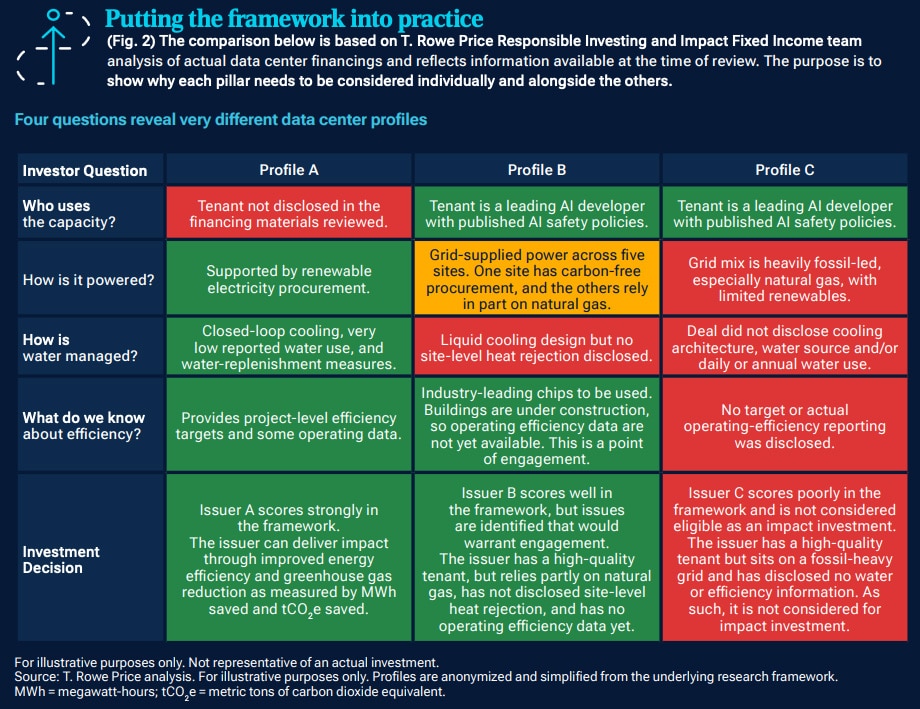
In our experience, data centers rarely present a uniformly strong or weak profile. Our framework is designed to highlight those differences by assessing each asset across four dimensions and examining the quality of the underlying evidence. The objective is not to classify every data center as simply “good” or “bad.” It is to provide a structured way to compare deals and identify negative environmental and/or social externalities that remain unresolved.2 The framework is also useful for assessing where a project may make a positive contribution and potentially qualify for inclusion in our impact or labeled bond strategies.3
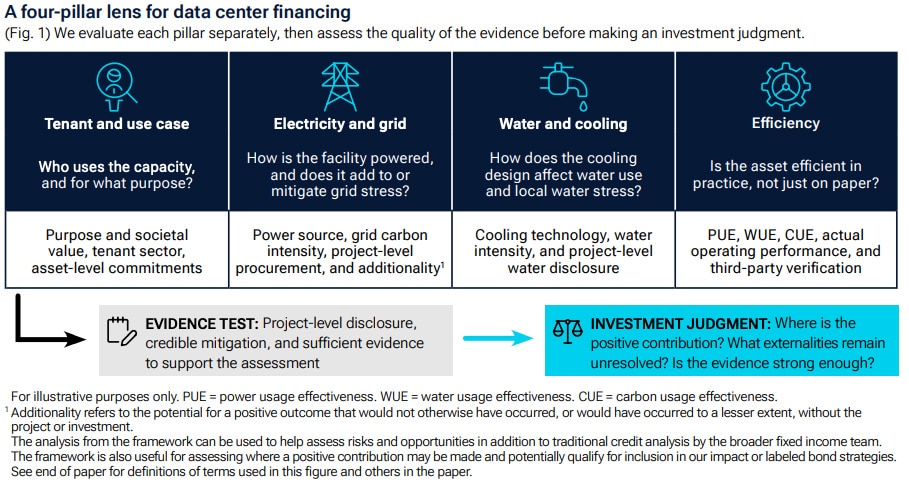
We have built our project‑level framework around the four pillars outlined below in Figure 1. For fixed income investors, we believe the framework provides a consistent basis for assessing bonds, securitizations, or project‑finance structures.
Tenant and use case
The tenant and use case pillar evaluates who is using the data center capacity and whether that use is aligned with an impact mandate. A tenant supporting enterprise productivity, health care, education, cybersecurity, scientific research, public‑sector digital infrastructure, financial inclusion, or climate solutions would generally achieve the highest score. General‑purpose cloud and AI infrastructure require more judgment. Our view is that producing more intelligence using less energy is core to an energy efficiency impact thesis, so the assessment is whether the capacity can deliver on it. By contrast, use cases such as social media optimization would score poorly.
Beyond the use case itself, we look at the tenant, including whether workloads are broad and diversified; whether it has credible sustainability commitments and, for AI developers, published governance and safety policies; and whether those commitments apply to the financed asset and not only at the corporate level.
Electricity and grid
The electricity and grid pillar evaluates how the facility is powered and whether the project contributes to or mitigates grid stress. Because data centers are large‑load customers, the impact case depends on the source of power, the carbon intensity of the local grid, and the presence of project‑specific renewable or carbon‑free procurement. We also ask whether the project requires new fossil generation or transmission upgrades. Stronger scores require credible clean‑power procurement, preferably project‑level and local, with evidence of additionality through power purchase agreements, storage, demand response, green tariffs4, or dedicated grid investments.
Some of this is within an issuer’s control, and some is not. Procurement, additionality, and disclosure are choices the issuer makes, while the regional grid mix and interconnection constraints largely are not. Where grid information is missing, we reference the local grid mix, so regions with higher renewables penetration will naturally score better. Who pays also matters because it is a common trigger for community pushback. A project that passes the cost of new supporting infrastructure on to residential and small business ratepayers scores lower in our framework.
Water and cooling
The water and cooling pillar evaluates whether the project’s cooling design creates local water risk. This is a critical part of data center diligence, since cooling choices can create water externalities that energy metrics do not capture. The framework rewards closed‑loop, dry‑cooling, air‑cooled, pumped‑refrigerant, liquid‑cooling, and other low‑consumptive‑water designs, particularly where water use is disclosed at the project level. It penalizes evaporative cooling or material water consumption in water‑stressed regions, especially where the water source, permitting status, expected daily use, or community concerns are not disclosed.
As with power, part of this is within the issuer’s control. Cooling technology and water disclosure are the issuer’s choices, and low‑consumptive designs can materially reduce water use. Local water stress is not, so the same design carries different risk in different places, and location counts in the score alongside technology. Water stress is also a leading source of community pushback. Where a facility competes with residents, farms, and other users for scarce supply, opposition is more likely, and permitting is harder, so a project in a water‑stressed area with material local opposition scores lower.
Efficiency
The efficiency pillar evaluates overall resource intensity, using power usage effectiveness (PUE), water usage effectiveness (WUE), and, where relevant, carbon usage effectiveness (CUE). The framework will take a more positive view of the actual operating performance over design estimates and project‑level reporting over portfolio‑level claims. Because many investment grade deals are still under construction, we plan to engage and reanalyze them once the data centers are operating. Strong scores require evidence that the financed asset is efficient in practice, not just marketed as green.
Relevant considerations include actual or expected PUE and WUE, cooling architecture, efficient power systems, graphics processing unit efficiency, server utilization, workload optimization, building certifications, and third‑party verification. We would also like to see issuers disclose CUE, but it is rarely reported today. Of the four pillars, this is the one an issuer can most directly demonstrate, through measured operating data and independent verification. Where only design‑stage figures or portfolio‑level claims are available, the score is weaker.
Can data center deals generate positive impact?
As labeled and non-labeled data center deals take a growing share of issuance, investors are being asked to decide whether any of them can credibly sit in an impact portfolio.5
The case for impact is real but conditional. Data centers are increasingly central to cloud computing, enterprise productivity, artificial intelligence, cybersecurity, scientific research, and other digitally enabled activities. Where a facility serves these uses and produces more computing with less energy, a financing may contribute to genuine efficiency gains. In our view, producing more intelligence using less energy is core to an energy efficiency impact thesis, and the “best-in-class” data centers identified through our framework align through increasing energy efficiency.
A framework designed to assess a fast‑growing market
For fixed income investors, the aim is to bring greater underwriting discipline to a fast‑growing part of the market. Data center developments can create significant environmental and social externalities, but they also can support important economic and sustainable outcomes. The investment judgment therefore depends on understanding both sides, namely where a deal may create incremental positive contribution and where risks remain. It also requires assessing how those risks could transmit into project economics and bondholder outcomes, and whether the available project‑level information is sufficient to support the investment case. Ultimately, the analysis comes back to the asset itself, from what it contributes, to what risks it creates and how confidently those characteristics can be assessed. As the data center market grows, I believe asset‑level analysis of this nature will be critical to identifying opportunities while managing risks for bondholders.
“For fixed income investors, the aim is to bring greater underwriting discipline to a fast‑growing part of
the market.
– Matt Lawton, CFA, Portfolio Manager, Head of Impact Fixed Income
1 International Energy Agency (IEA), Key Questions on Energy and AI, April 16, 2026. The IEA estimates global data center electricity consumption at 485 TWh in 2025 and around 950 TWh in 2030 in its central projection. iea.org/reports/key‑questions‑on‑energy‑and‑ai
2 A negative externality refers to a negative sustainability or impact outcome arising from the production or consumption of a good or service, while a positive externality refers to a positive sustainability or impact outcome.
3 Impact investing strategies seek to generate positive, measurable environmental or social outcomes alongside financial returns. Labeled bond strategies invest in bonds designated for specific environmental or social purposes, such as green, social or sustainability bonds.
4 Green tariffs are utility pricing arrangements that allow customers to buy renewable electricity through their electricity provider.
5 Source: J.P. Morgan, as of September 30, 2026. AI-related companies are approximately 14.5% of the J.P. Morgan U.S. Investment Grade Corporate Bond Index, up 3 percentage points from 2020. J.P. Morgan estimates the share could rise to >20% by 2030 under current capital expenditure assumptions. Please see Additional Disclosures for more information.