


















Strong US corporate bond issuance and demand show no signs of letting up with calendar year-to-date issuance of around US$309 billion, up almost 30% on the same time last year. AI deals, as mentioned in previous notes, have contributed billions. PGIM ran some of the numbers regarding AI’s potential to destroy value after strain across the software sector this week.
US investment grade spreads have tightened to near record levels at 75 basis points (0.75%), and new issue concessions, where additional spread is provided to make sure the raise is successful, has fallen to a low 2 basis points.
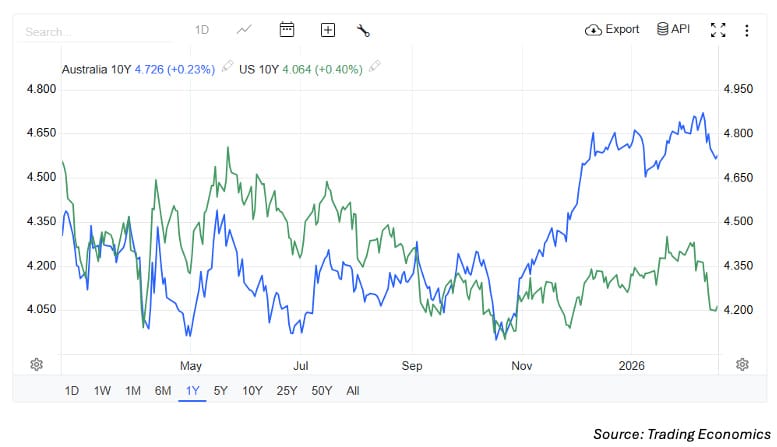
US markets are expecting two further rate cuts this year, while at home, we’re expecting at least one more hike, possibly two. So, we have this massive difference between US and Australian 10-year government bond yields, see the chart below showing the Australian yield in blue and the US in green, helping to attract foreign investors.
Issuance is also strong in the Australian market, and subordinated Tier 2 issues feature in the list of recent new issuance below, with ANZ, Westpac, and Credit Agricole issuing senior and subordinated deals:
- ANZ raised $1 billion in a 11NC6 (11 years, non call six) Tier 2 sustainable bond deal. The deal tightened five basis points from initial price guidance.
- A $725m floating rate tranche priced at 125 basis points over 3-month BBSW
- A $275m fixed to floating rate tranche priced at 125 basis points over semi quarterly swap
- Avanti Finance raised $150m in a senior secured floating rate note with a margin of 415 basis points over 3-month BBSW
- Macquarie Bank raised $1.25 billion in a 10.5NC5.5 Tier 2 deal. The deal tightened eight basis points from initial price guidance.
- A $850m floating rate note at 132 basis points over 3-month BBSW
- A $400m fixed-to-floating tranche with a 5.757% issue yield
- Rabobank is taking indications of interest (IOI) for three and five-year senior unsecured bonds
- IMB Bank raised $100m in a 10NC5 Tier 2 deal which priced at 3-month BBSW +185 basis points
- Korea Gas Corporation, KoGas has mandated a four-year kangaroo deal
- UBS has priced a $1 billion Additional Tier 1 fixed rate deal at 7.125%
- DBS has raised $2 billion in a dual tranche senior unsecured deal:
- $1 billion in a floating rate tranche at 54 basis points over 3-month BBSW
- $1 billion in a fixed tranche at a 5.065% issue yield
- Watercare Services raised $500m in a 5.5-year senior secured bond with a 5.203% issue yield
- IMB Bank is taking IOI for a 10NC 5 Tier 2 deal with price guidance of 210 basis points over 3-month BBSW.
There were a couple of large issues that I missed reporting earlier this month:
- Credit Agricole raised $2.25 billion in three tranches, including a Tier 2
- Senior preferred fixed tranche $850m with a 5.35% issue yield
- Senior preferred floating rate tranche $400m at 92 basis points over semi quarterly swap
- Subordinated Tier 2 $1 billion 15NC10 at 6.447% or 172 basis points over semi-quarterly swap.
- Westpac raised $4.5 billion in three tranches, including a Tier 2
- Senior unsecured fixed tranche $1.6 billion with a 5.141% issue yield
- Senior unsecured floating rate tranche $1.4 billion at 68 basis points over semi quarterly swap
- Subordinated Tier 2 $1.5 billion 15NC10 at 6.085% or 133 basis points over semi-quarterly swap.
Private credit is a sought-after fixed income sub sector and PGIM has published an article explaining why they like large cap issuance. Interestingly, in the US, private and public issuance was near par last year, and companies are using both to find the cheapest and most favourable in which to borrow.
Duration, or taking interest rate risk, is one strategy investors use to make outsized returns. Laura Cooper from Nuveen weighs opportunities in global government bond markets.
Capital Group set out their expectations for 2026. There are some neat tables in this article showing actual 20-year annualized returns for US equities and bonds. US equities are projected to underperform long-term annualised rates, while bonds, excluding high yield, are expected to outperform.
Chamath De Silva from Betashares discusses our AI underweight AusBnd Credit Index and how the domestic market might benefit from global funds looking to limit AI exposure.
In important news, Nuveen is set to acquire Schroders, and Kapstream has announced a new listed investment trust.
Have a great week!