


















Portfolio Managers Mark Richardson and Robert Shimell at Janus Henderson explore how trend following strategies can help investors to adapt when market leadership shifts and traditional diversification becomes less reliable.
How does trend-following work?
- Trend following is a systematic investment approach that seeks to capture sustained price movements across global financial markets. These strategies typically operate as multi asset portfolios, aligning exposure with prevailing momentum across equities, fixed income, commodities, rates, and currencies.
- Implementation is commonly achieved through futures contracts, which allow efficient access to markets, the use of leverage, and daily liquidity. Trend-following strategies aim to ‘ride’ market trends by increasing exposure to assets that are showing a directional trend, and reducing or reversing exposure during ‘trendless’ periods. They can potentially profit in both rising markets and falling markets by taking long positions in assets with upward momentum and short positions in assets with downward momentum.
- Rather than forecasting economic outcomes, trend-following relies on observable price behaviour, seeking diversification benefits and resilience across different market environments.
Trends are multi-dimensional
Trends vary not only across asset classes and geographies, but also across time horizons. Shorter‑term trends can emerge around policy surprises, positioning shifts, or abrupt changes in risk appetite. Longer‑term trends tend to reflect structural forces such as deglobalisation, energy transition dynamics, demographic change, or sustained cycles of technological investment.
Good trend-following strategies think deeply about how to allocate. A strategy that incorporates multiple time horizons, with the ability to take both long and short positions, may be better positioned to navigate both transient shocks and longer‑lasting regime shifts in an increasingly fragmented world.
In practice:
- During rising markets, trend signals may increase exposure to risk assets, while reinforcing themes through cyclical commodities or pro‑growth currencies.
- During falling or trendless markets, exposure can be reduced, shorted, or redirected towards assets perceived as more defensive, such as the US dollar, Treasuries or gold.
In this way, dynamic trend-following strategies offer a disciplined framework for navigating uncertainty without relying on static assumptions or forecasts, with the potential to generate performance in both up markets and down.
Three key benefits of a trend-following strategy:
- Adaptability, diversification, and potential downside resilience: By responding to observable price behaviour, trend‑following can participate in sustained market rallies while reducing or reversing exposure during prolonged declines.
- Differentiated drivers of performance: Because the opportunity set spans multiple asset classes, returns are driven by the presence of trends rather than the performance of any single market. This has historically resulted in low correlation to both equities and bonds, particularly during periods of market stress.
- Asymmetric return profile: Trend strategies typically seek to limit losses when trends reverse while allowing gains to compound during extended moves, contrasting with the negatively skewed return profile often associated with equities.
Trend is your friend… if you blend
Today’s markets are characterised by higher volatility, unstable inflationary pressures, persistently higher interest rates and increased geopolitical risk. These conditions have challenged the diversification benefits between equities and bonds that have underpinned portfolio construction since the latter part of the 20th Century. As correlations shift and macro regimes change, static allocations may struggle to deliver the balance of growth and defensive characteristics that investors expect.
In practice, trend‑following can help address some of the structural limitations of traditional multi‑asset portfolios, such as the widely used 60/40 equity-bond allocation.
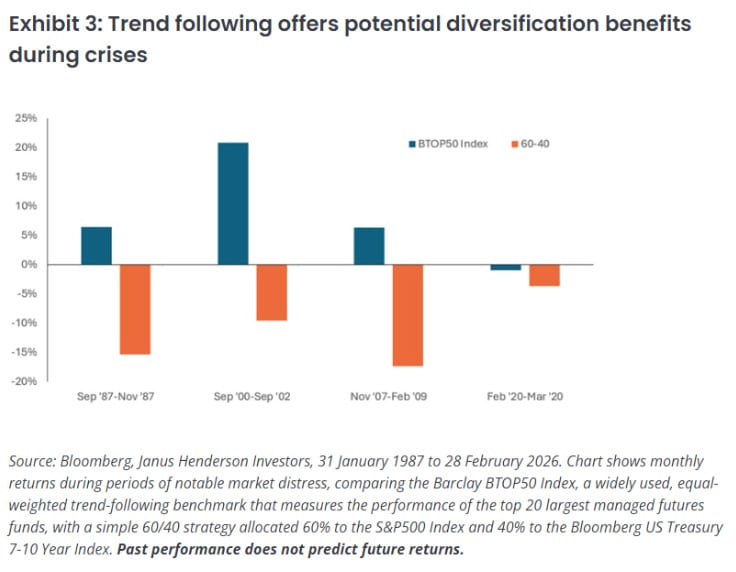
History indicates that trend-following strategies can deliver what is often referred to as ‘crisis alpha’. During episodes such as the Dot‑Com collapse of 2000–2002 and the onset of the Global Financial Crisis in 2008, these strategies demonstrated notable resilience in periods of heightened market stress (Exhibit 3).
Following trends, not narratives
The market surprises of recent years have highlighted the limitations of portfolios anchored to a single narrative or static allocation. As markets move through 2026 and beyond, leadership can shift quickly – not only within equities, but across asset classes and regions. This is an area with huge potential to grow, where many investors are arguably underinvested, given that this segment of the market is a fraction of the market cap of single stocks like Apple or NVIDIA.
Liquid, systematic trend‑following strategies, operating across assets and within a long/short framework, offer a way to respond to these evolving conditions. Rather than relying on consensus forecasts or fixed assumptions, they seek to align exposure with prevailing market momentum across equities, bonds, rates, commodities, and currencies – keeping investors participating in a trend for as long as it runs and removing the human biases that can influence positioning.
Crucially, trends are not confined to rising markets. They can emerge during periods of stress, transition, or consolidation, and across multiple time horizons. For investors seeking greater resilience in an uncertain world, a trend-following strategy offers the ability to adapt systematically as conditions change –a very valuable attribute for any portfolio to have.