



















When we think about the current volatility, we are reminded of a prescient quote from
Russian revolutionary and president Vladmir Lenin: “There are decades where nothing
happens and there are weeks where decades happen.” Time will tell whether the Iran war is indeed one of these periods where decades happened.
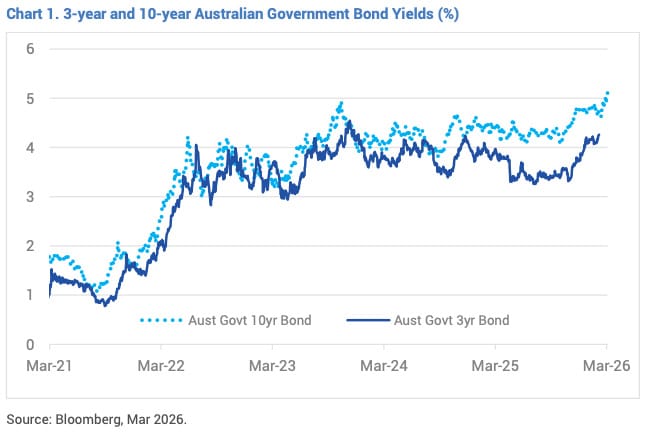
As for markets domestically, higher oil prices have collided with sticky headline inflation and a hawkish central bank. Australian government bonds have sold-off aggressively in March, with 3 and 10-year bond yields now at ~4.8% and 5% respectively (refer Chart 1). Moreover, despite the Reserve Bank of Australia (RBA) increasing the cash rate twice in February and March 2026 to 4.1%, interest rate markets as of 20 March were pricing in another ~70bps of tightening by the end of 2026 to 4.8% (i.e. close to another three 25bps increases in the RBA cash rate).
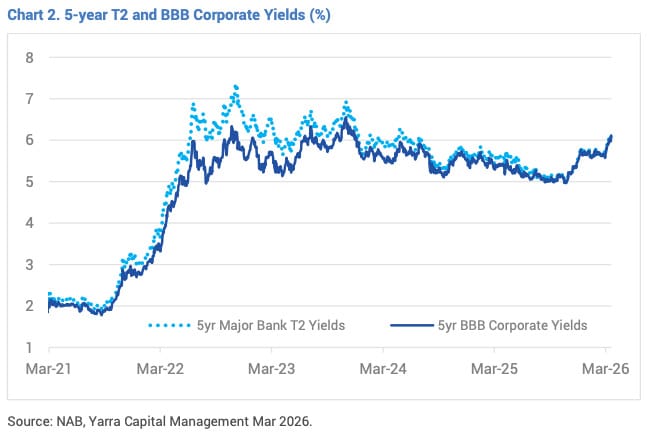
This higher rebasing of interest rates has a commensurate impact on corporate bond yields,
with 5-year major bank T2 and triple B corporate yields now both back above 6% for the first time since late 2023 (refer Chart 2).
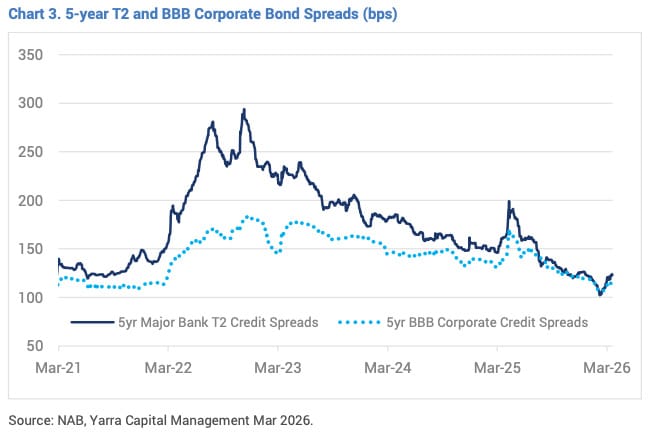
By contrast, the movement wider in investment grade (IG) credit spreads of ~20bps only
takes us back to late 2025 levels (refer Chart 3). The orderly behaviour of IG credit thus far is testimony to the power of higher risk-free rates and outright yields (i.e. lessening the
pressure on credit spreads to achieve investor return targets). Moreover, for the most part
risk markets are still pricing in a speedier return to normalcy, enabling central banks such as the RBA to raise rates despite the heightened uncertainty.
When uncertainty in markets is elevated, playing the averages over the medium term
typically remains the best course of action. In many ways, what we’ve experienced in recent months, turbocharged by the Iran war, is a mini 2022 period with one important caveat. After the normalisation of bond yields in 2022, travel time to higher bond yields in 2026 was shorter and much less painful for interest rate duration positions.
From our perspective, while holding some duration has been reflected in performance in
recent months, our focus has remained on taking advantage of higher outright yields and
locking in attractive income. Portfolio running yields for the IG quality Yarra Enhanced and
Higher Income funds are now well above 6% and approaching 7%, levels we last generated in 2023/24. Maintaining duration in portfolios at these elevated levels is advantageous for
sustaining performance throughout the remainder of 2026.
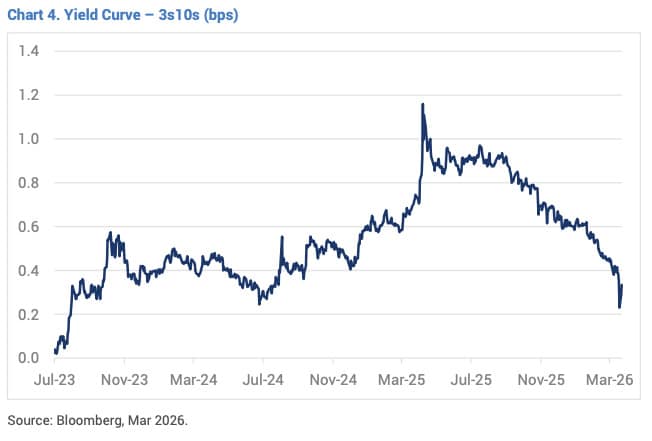
In addition to higher bond yields, the rebuilding of more rate hikes in market pricing has
significantly flattened the yield curve. The difference between the 3 and 10-year bonds is
now under 30bps, down from a peak of ~120bps during the liberation day selloff in April
2025 (refer Chart 4). In this environment and if sustained, a flatter yield curve should result in a steeper credit curve with investors at the very least demanding increased term premium in the current environment (i.e. higher credit spread compensation for longer dated securities).
While credit spreads remain well behaved, if the current interest rate pricing is even half
realised – i.e. reflective of some RBA future hikes – then a significant deflationary impulse
for the Australian economy is likely. This is especially the case when combined with an
appreciating $A, much higher petrol prices, greater application of AI tools across the
economy and a retreating public sector following a more austere May Federal budget.
Resultant higher unemployment and much weaker economic growth is likely to reverse
current interest rate settings through the course of 2026/27. Therefore, despite a small
impact in recent months, maintaining interest rate duration in portfolios continues to make
sense at current levels.
In an environment of much weaker growth and higher unemployment, rallying bond yields is likely to result in credit spreads moving wider, with the current calm in credit giving way to a further rebasing of spreads. Our focus remains on locking in favourable income and using duration and curve to protect the portfolio and strongly position us to take advantage of the transition in return composition, with credit spreads likely to comprise a greater proportion of future outright yields following a significant decline in risk free rates.
Ultimately, the power of higher running yields in the 6-8% range, active management
and IG quality portfolios should provide a strong platform for continued attractive
through-the-cycle returns for Yarra’s Enhanced and Higher Income funds.