



















Each quarter, Aviva plots a course through global fixed income markets by distilling top-down macro perspectives and bottom-up market intelligence. Compass draws on the insights our “Matrix Pods” – dynamic, cross-functional groups that unite subject matter experts including portfolio managers, strategists, economists and traders.
The latest Compass summary:
- Volatility changes pace
Fixed income markets have moved from a phase of acute and indiscriminate disruption to a prolonged phase of re-adjustment.
- Competing risks
Inflation and central bank tightening is the immediate risk, but risks to economic growth pose a longer-term challenge.
- Carry is still core
Despite the turbulence, fundamentals so far remain intact and carry remains the driver of fixed income returns.
- Protection and selection
Investors should focus on selection for credit quality and resilience rather than exposure to broader market moves (beta).
- Emerging market opportunities
Within EM, the most compelling opportunities are in local assets. Large price adjustments and widespread position reductions have reset valuations, creating attractive opportunities.
Fixed income markets were already in the late stage of the credit cycle, but the elevated conflict risk, energy price uncertainty and persistent inflation sensitivities have reinforced that dynamic across markets. In such an environment, the central question is not whether risks exist, but how markets will respond to them. Will they shift abruptly? Or will we see a more prolonged and uneven adjustment?
The view from our most recent round of Matrix Pods is that while downside risks remain firmly present, the balance of probabilities has shifted away from a single, sudden dislocation and towards a period of ongoing volatility and cross-currents.
During the early stage of the recent Middle East conflict, defensive positioning was both prudent and necessary, but as the crisis has continued, the emphasis has moved away from pure protection. This is not complacency, but a reassessment of the speed at which markets are moving. The consensus from our Matrix Pods was that over the weeks ahead there is a reduced likelihood of indiscriminate, rapid widening in spreads and instead a greater emphasis on path dependency, differentiation and income discipline.
In that setting, carry regains relevance, not as a reason to ignore risk, but as reminder that when fundamentals remain broadly intact and an adjustment is taking place over time, elevated all-in yields are still a powerful contributor to overall returns.
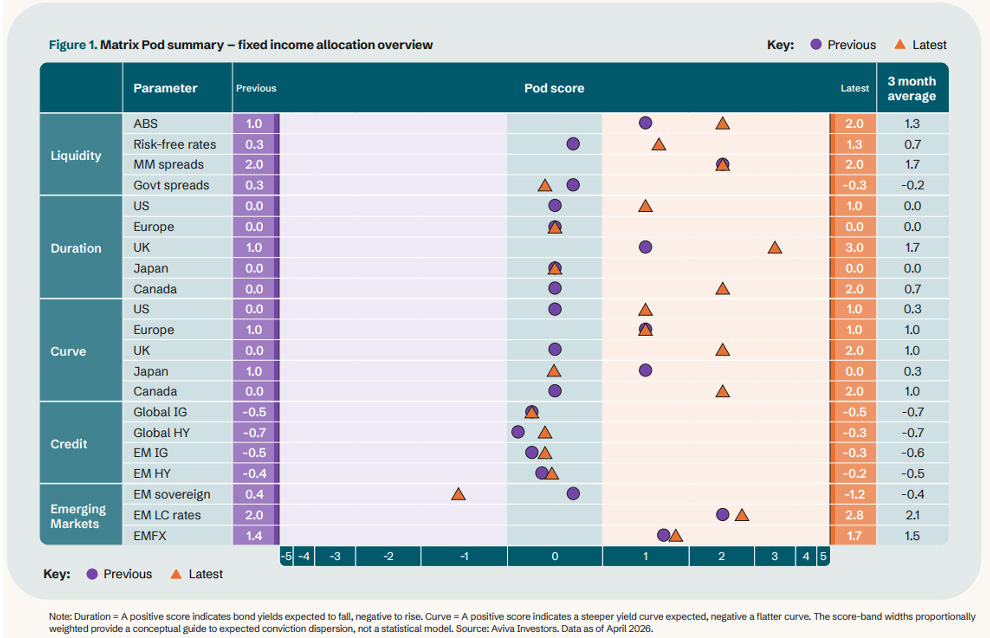
Discussions across credit, rates, liquidity and emerging markets (EM) have consistently reinforced the importance of selectivity, quality bias and resilience, rather than broad beta exposure (see the Matrix Pod summary table in Figure 1).
Fixed income markets are undergoing a protracted adjustment to the changed global economic environment. Risks cannot be ignored, but fundamentals are intact. In such an environment, carry will continue to be the workhorse of fixed income investment.
In volatile conditions, protection is not solely about dampening risk, but about maintaining agility — allowing portfolios to remain resilient while retaining the ability to benefit from dislocation whenever volatility becomes a potential source of return.
Rarely have flexibility, real-time analysis and insight been so important for fixed income investment.
The team remains selectively bullish, with its strongest conviction in front-end UK rates. Conviction has increased on asset-backed securities (ABS) and money markets but remains mostly neutral on government bonds, apart from a slight bearish stance in the UK. Conviction is low on investment grade (IG) credit and the view on covered bonds continues to be neutral.