
















The Consumer Price Index rose 3.8% for the 12 months to May 2026, down slightly from 4% in April. Trimmed mean inflation, the RBA Policy Board’s preferred measure was steady at 3.6%. The largest contributors were housing at 6.8%, food and non-alcoholic beverages at 3.3% and recreation and culture at 3.3%.
Housing remains the largest contributor to inflation and is likely to continue to be so given housing shortages, rising input costs from both materials and labor, with shortages in trades.
The 3.6% trimmed mean rate feels like it has stabilised, not great for the RBA Board whose target range is 2-3%. At the same time, a reignition of hostilities in the Middle East could further fuel inflation in coming months. On the flip side, consumer confidence is low, with the Westpac-Melbourne Institute Index of Consumer Sentiment showing an improvement, but pessimism still dominates.
Australia RBA Trimmed Mean CPI YoY
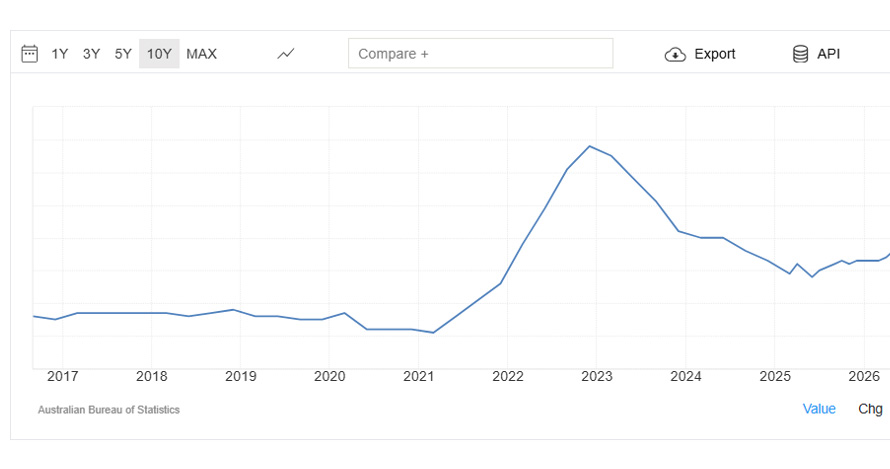
While I’m not an economist, if the RBA Policy Board is still aiming to keep inflation between 2-3%, they should hike.
However, I think it’s more likely they’ll keep the rate on hold. They’ve already increased three times and will be reluctant to hike again and add to further cost of living pressures and negative sentiment.
Talking about inflation, we publish this excellent article about the next inflation hit, from Melanie Baker at Royal London Asset Management. There are multiple forces building to suggest food inflation will be next.
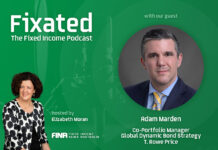
We have a new podcast. Last week I interviewed Adam Marden, who is a portfolio manager at T. Rowe Price about how he navigated the last, volatile quarter. We also talk about inflation, yield curves and Australian bonds compared to global offerings.
The US Fed meets overnight, and commentators widely expect the current Fed Funds rate to stay the same at 3.5-3.75% for a fifth consecutive meeting. Views on rates vary widely. Here are a few insightful comments:
Laura Cooper, Head of Macro Credit and Global Investment Strategist at Nuveen – Markets are repricing the Fed policy path before Warsh has said a word. Treasury yields climbed sharply as higher oil prices renewed inflation concerns, leaving investors to assign greater probability to a near-term hike. With policymakers in a blackout period and no fresh communication available, investors have been forced to do what they will have to do more of under Chair Warsh: infer policy from incoming data rather than forward guidance.
Robert Sockin, Chief US Economist at PGIM – Our assessment is that hawkishness at the Fed is reaching a critical mass. It is this backdrop that makes the July meeting such a close call. The minutes for the June FOMC meeting effectively said that energy, tariffs, and AI have accelerated inflation over the past year, and if any of these factors keep inflation elevated the Fed may have to hike. The sharp run-up in energy prices, new tariff announcements, and rising AI Capex guidance arguably satisfy this reaction function—which is why we think it is almost a 50/50 call that they hike next week.
Blerina Uruci, Chief US Economist at T. Rowe Price – My baseline forecast is for the FOMC to stay on hold over the next twelve months, with significant tail risks in both directions. The rates expectation is driven by my forecast of a benign inflation outlook in H2 2026. While the elevated risks of hikes reflect uncertainty around the energy shock, near-term upside risks to inflation remain from AI and a potential acceleration in the labour market… I will be watching the number of dissents as an indication of the range of views within the FOMC…More than three dissents would be a clearer sign that the committee is moving toward a September hike, even if it remains on hold in July.
We’ve started to cover some alternative asset classes, and Luke Ferguson from Ferguson Hyams Asset Management suggests domestic food production as a possibility in this sponsored article.
T. Rowe Price has published its popular, monthly global asset allocation article.
Harvey Bradley from Insight Investment wonders what has been driving positive correlations between government bond yields and oil prices.
Finally, private credit articles continue to be read widely, and CFMG Capital Group’s Andrew Thomson suggests ways to test the resilience of your private credit investments.
In Australian corporate bond news this week:
- Agricultural Bank of China Sydney raised $700 million in a three-year floating rate note priced at 55 basis points over 3-month BBSW
- DWPF Finance raised $300 million in a senior unsecured five-year fixed rate bond priced at 135 basis points over semi-quarterly swap
- Royal Bank of Canada Sydney Branch raised $2 billion in a five-year covered bond priced at 57 basis points over 3-month BBSW.
Hope you’re having a great week!