

















Thomas Poullaouec, Head of Global Investment Solutions, International and Portfolio Manager at T. Rowe Price, and his team have published their latest insights on global asset allocation and the investment environment for Australia. June 2026.
OUTLOOK
Markets have continued to push higher despite geopolitical uncertainty, supported by resilient earnings and ongoing AI-driven investment, even as inflation and policy risks remain.
The global economy continues to benefit from fiscal spending and investment in AI infrastructure, though growth is becoming more uneven across regions and the path of energy prices remains uncertain.
The policy outlook remains uncertain as central banks balance lingering inflation pressures against concerns about moderating growth and a gradually softening labor market, leaving the path for interest rates increasingly data dependent.
Despite receding risks of a prolonged energy supply shock, tighter monetary policy and proposed housing policy changes create a challenging backdrop for Australia’s economy.
Key risks include a renewed rise in energy prices and inflation, further geopolitical escalation, continued reliance on a narrow set of market leaders, and signs of deterioration in labor markets or private market liquidity.
THEMES DRIVING POSITIONING
Fed Gets Less Chatty
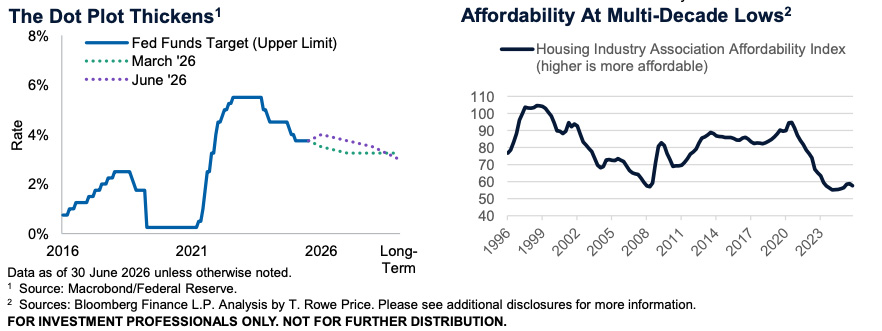
The arrival of a new Fed chair appears to have changed the policy backdrop, though not necessarily by putting rates on a meaningfully different near-term path. The bigger shift may be in communication: Kevin Warsh appears less inclined to guide markets toward a specific policy outcome, placing greater emphasis on incoming data and making the path of policy less predictable. This matters because inflation remains the Fed’s primary constraint. While signs of labor market softening could increase pressure to ease policy, they may no longer be enough on their own to prompt rate cuts, particularly with inflation still above target. In other words, while inflation remains above target, investors may not be able to count on the Fed to respond quickly to every bout of market or economic weakness, as policymakers place greater weight on maintaining inflation credibility. Importantly, this shift extends beyond the new chair. The latest Fed projections showed a broader committee-wide move away from cuts and toward the possibility of hikes, despite political pressure for easier policy. For investors, that points to continued rate and yield curve volatility and reinforces the case for a cautious stance on duration.
Also read: Risk Assets Have To Earn The Second Half
Australia’s Housing Reset
The recent drop in oil prices should bring some relief to Australia through lower fuel costs. However, we believe the domestic outlook still looks challenging. Underlying inflation, which began to reaccelerate even before the Iran war-induced energy supply shock, remains sticky and broad-based. In response, the Reserve Bank of Australia has raised borrowing costs three times this year. The Federal Budget added a new shock to the system as the government overhauled property investment incentives, removing capital gains tax discounts and limiting negative gearing benefits. Although intended to improve housing affordability over time, these reforms are likely to trigger a period of deleveraging, dampening housing activity, home prices, and household wealth, eventually contributing to a consumption-led economic slowdown. A combination of weaker growth and elevated inflation increases stagflation risks and raises uncertainty for corporate earnings. Therefore, we remain underweight Australian equities, particularly financials, where earnings expectations continue to soften despite demanding valuations. We also see downside risks for the Australian dollar as domestic economic weakness contrasts with a more resilient U.S. economy.
ASSET CLASS POSITIONING
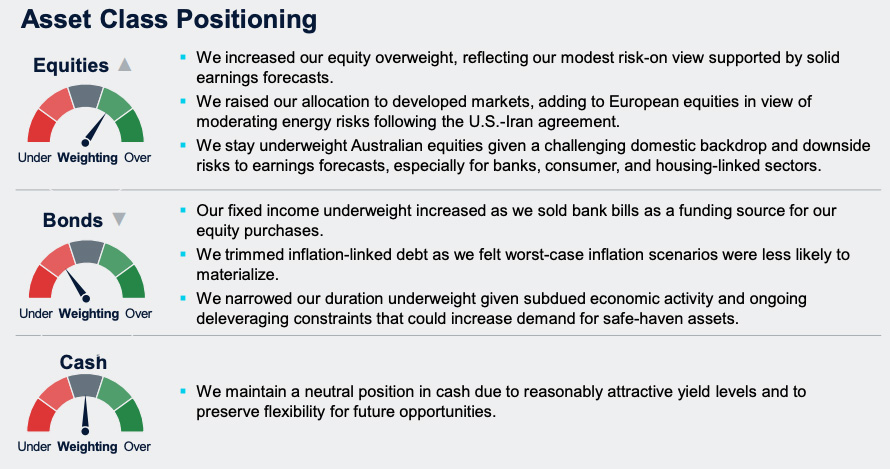
Note: T. Rowe Price’s Australia Investment Committee comprises local and global investment professionals who apply views from the firm’s Global Asset Allocation Committee to make informed asset allocation views from an Australian investor perspective. The Committee is led by Thomas Poullaouec, Head of Multi-Asset Solutions APAC, based in Singapore.