



















Commonwealth Bank of Australia (CBA) has launched a new index measuring uncertainty in the Australian government bond market, with initial findings suggesting investors remain relatively calm despite rising bond yields and expectations of higher interest rates.
The Australian Government Security Volatility Index (AGSVIX) measures implied volatility in Australian government bonds, providing a new benchmark for assessing market uncertainty.
Comparable to the widely followed MOVE Index for US Treasuries, the AGSVIX tracks uncertainty priced into bond options markets, offering investors an additional tool for assessing fixed income market conditions.
CBA’s research shows that while Australian bond yields have risen over the past year, implied volatility has declined, suggesting an orderly adjustment to expectations that the Reserve Bank of Australia (RBA) will maintain higher interest rates for longer.
The bank’s analysis identifies two key drivers of bond yields: expectations for future interest rates and inflation, and the term premium, which represents additional compensation investors demand for holding longer-dated securities.
Importantly, the research found these factors have different impacts on market volatility.
Higher yields driven by changing interest rate expectations can coincide with declining uncertainty, while increases driven by higher term premiums typically generate greater volatility.
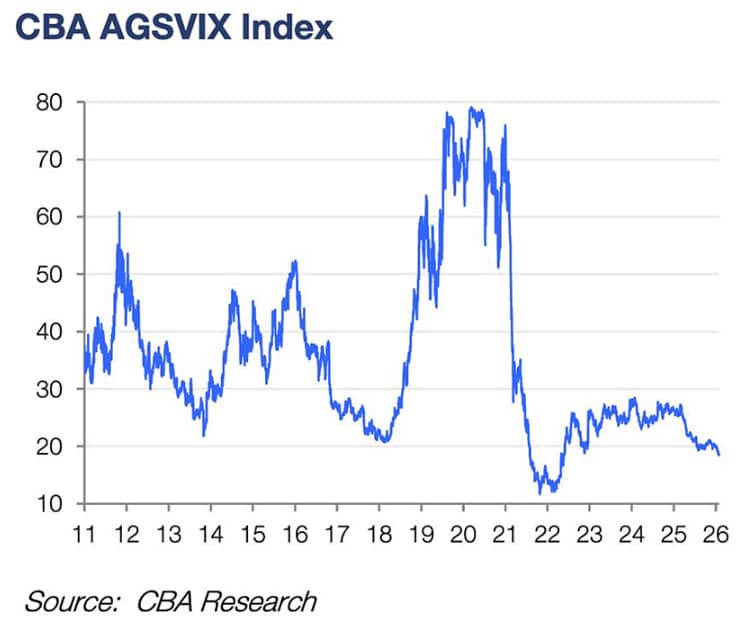
CBA Director of Fixed Income and Interest Rate Strategy Hamid Yahyaei said the findings suggested investors were adjusting their expectations rather than questioning the RBA’s credibility.
“Our subdued AGSVIX points to an orderly repricing of ‘higher for longer’ policy rate expectations rather than a loss of credibility for the RBA,” Yahyaei said.
The research suggests credible central bank action to contain inflation can increase expected interest rates while reducing the term premium, as investors become more confident about longer-term inflation outcomes.
However, CBA cautioned that unusually low implied volatility could leave Australian fixed income markets vulnerable to unexpected shocks.
“Implied volatility is already very low, which does leave the market vulnerable to a sharp widening in the variance risk premium (VRP) if a term premium shock widens the range of possible yield outcomes,” Yahyaei said.
The findings highlight the importance of distinguishing between rising yields driven by monetary policy expectations and those reflecting increased investor risk premiums, particularly as Australian bond markets navigate persistent inflation and changing interest rate expectations.