



















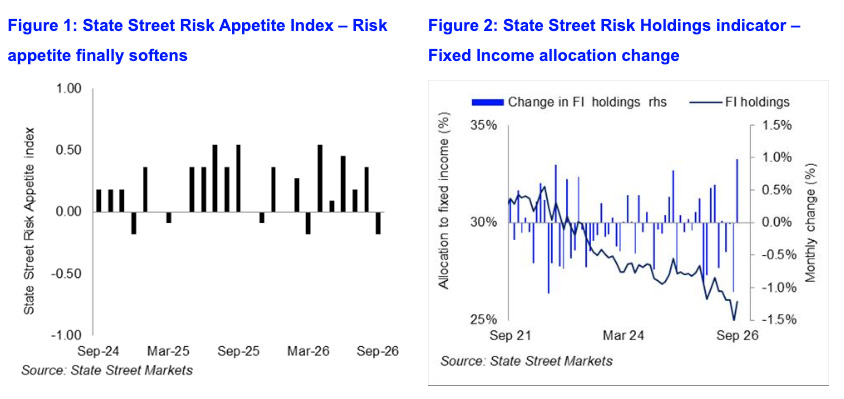
The State Street Risk Appetite Index fell to -0.18 in September from 0.36 in August, its weakest reading since March’s outbreak of war in Iran and the end of a five-month run of institutional risk-taking.
Equity allocations remain historically high at 56.6%, but fell 0.8 percentage points in September. Fixed income—not cash—benefited: allocations excluding bills rose nearly a full percentage point, while cash fell 0.18 percentage points. This was the largest monthly increase in fixed income allocations in just over five years. Although holdings remain historically low, September’s surge suggests long-term investors are finally responding to higher sovereign yields despite the difficult macroeconomic outlook.
APAC-specific findings include:
- Institutional risk appetite finally broke its five-month winning streak, as high equity exposure, rising oil prices and the beginning of another Fed tightening cycle persuaded investors to pause. This was especially true of foreign demand for Korean equities which saw amongst the weakest equity flows across emerging markets in the month.
- The bigger surprise was not that investors reduced equity risk, but where they went next: bonds, not cash. September produced the largest monthly increase in fixed-income allocations in more than five years, even as US long-term yields rose sharply.
- With fixed-income holdings near a 20-year low, the reaction in September may be the first real sign that sovereign yields are finally high enough to tempt long-term investors back into bonds, this is especially true of foreign demand for JGBs, which rose to a seven-month high in mid-September.
Michael Metcalfe, Head of Macro Strategy, State Street Markets commented:
“The failure of the risk-seeking run captured by the State Street Risk Appetite Index to reach a sixth month was unsurprising. Investors were already significantly overweight equities, while higher oil prices and tighter monetary conditions gave them clear reasons to pause. More surprising was where they sought safety. Sometimes the absent behavior is most telling: despite weaker price action in both equities and bonds, cash allocations fell modestly and remained below their long-term average. Instead, the 80bps decline in equity holdings and 20bps fall in cash went into fixed income securities, producing the largest monthly increase in more than five years. With asset managers’ fixed income holdings near a 20-year low, some rebalancing was overdue. But the shift came as yields rose sharply. It is the first sign that, despite concerns over inflation and the fiscal and political outlooks, longer-term yields are finally high enough to attract long-term investors again.”
About the indicators
The Institutional Investor Indicators (the three i’s) were developed at State Street Associates, State Street Markets’ research and advisory services business. They measure investor confidence or risk appetite quantitatively by analyzing the actual buying and selling patterns of institutional investors derived from State Street’s USD 56trn1 in assets under custody and administration (note not investors’ balances held at State Street itself). The Risk Appetite Index is derived from measuring investor flows in twenty-two different dimensions of risk across equities, FX, fixed income, commodity-linked assets, and asset allocation trends. The index captures the proportion of the twenty-two risk elements that saw either risk seeking or risk reducing behavior. A positive reading suggests that on balance investors are adding to their risk exposures, while a negative reading suggests risk reduction. State Street’s holdings indicators capture the share of investor portfolios allocated toward equity, fixed income and cash going back to 1998.