



















Memories of the eurozone debt crisis are roaring back as European government bond yields reach multi-year highs. That raises the stakes for the European Central Bank as France edges closer to its own crisis moment, with other markets on contagion watch. For now, early evidence points to repricing rather than contagion.
Fiscal fault lines
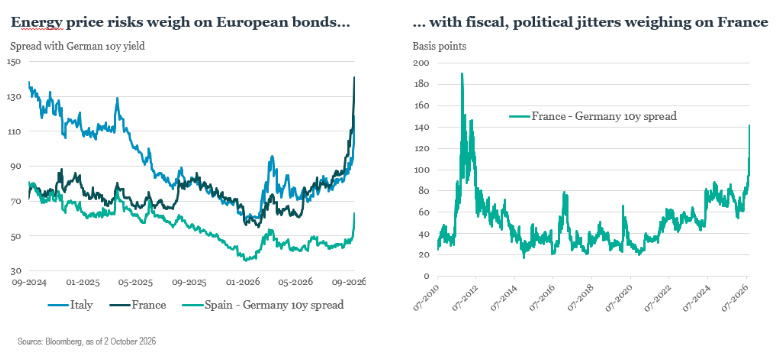
Renewed fiscal and political concerns in France are compounding pressures from the energy shock, with early signs of spillover emerging elsewhere. The spread between the French 10y yield and the German equivalent jumped last week to levels not seen since the stress of 2011-121. The magnitude of the move is striking given the 2027 election remains several months away, and France’s deteriorating fiscal dynamics are hardly new. What has changed is sharply higher yields, leaving investors less willing to look through those vulnerabilities.
The latest catalyst was the 2026 budget deficit tracking modestly higher than expected, at 5.4% of GDP versus a projected 5.1%2. The proposed 2027 plan includes some consolidation but remains open to negotiation and leaves the possibility of a rollover budget, implying a 6.5% shortfall for half of the year given the April election timing. The lack of meaningful fiscal restraint and medium-term reforms leaves the direction of travel unconvincing to bond investors.
Watching for spillover
The sell-off comes amid broader bond market pressure, from energy price risks and resilient growth to rising bets on renewed rate hiking cycles. European government bonds have tracked oil & gas prices more closely than Treasuries3. France, however, carries an embedded country-specific risk premium reflecting heightened political and fiscal risk.
The pace of the recent moves suggests position-unwinding rather than a sudden shift in fundamentals. That’s consistent with developments across the banking sector. French bank exposure to OATs sits predominantly in held-to-maturity portfolios, limiting mark-to-market losses, while trading-book exposure is small relative to CET1 capital4. Exposure is also uneven, with globally diversified banks carrying less concentrated domestic exposure. This points to price-sensitive holders unwinding positions rather than stress building in the banking system which suggests repricing rather than contagion.
The backup in yields creates a challenging feedback loop: higher yields raise debt servicing costs, worsening the fiscal trajectory and widening spreads further. Even so, French-specific factors still appear largely contained, with limited signs of spillover to the broader European rates complex.
The ECB’s Dilemma
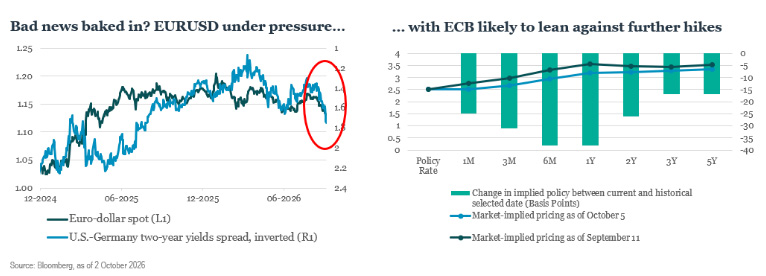
The level of OAT-Bunds is not the focus for the ECB. What matters is i) the speed of the move, ii) contagion to other sovereigns (i.e. fragmentation) and iii) the tightening of financing conditions.
The ECB has long maintained that it is not in the business of containing spreads and is unlikely to respond to a repricing of French political or fiscal risk alone5. Given the scale of the move, we expect the ECB to lean further against additional hikes, acknowledging that tighter financial conditions are already doing some of its work.
That calculus in maintaining a hawkish stance would shift if selling became disorderly or began impairing monetary policy transmission. Even then, the ECB would not need to intervene directly in French bonds to respond given several tools it has available. Verbal intervention comes first, followed by greater flexibility on QT or reinvestments, which could materially reduce France’s net funding needs. Targeted liquidity support is another lower-profile lever if bank funding conditions deteriorate. The Transmission Protection Instrument remains a backstop, although France’s eligibility would be a difficult question and the ECB has shown little appetite to deploy a tool that has never been used.
What we’re watching
Easing oil and gas prices are providing near-term relief, though upside price risks in Europe remain given low seasonal inventories heading into the winter and persistent geopolitical risk. These dynamics drag yields lower across the board rather than resolving France’s premium.
For us, the clearest signs of contagion would be sustained foreign selling of French debt, heavier French bank reliance on central bank liquidity, or spread pressure beginning to decouple from macro drivers like energy. We’re not seeing that yet: foreign inflows reached a record high over the 12 months to July, with no sign of outflows in August. But political uncertainty heading into 2027 warrants close watching.
Traditional sources of demand nevertheless look more hesitant to step in. Japanese investors have scope to reduce French debt once there is greater clarity on the Bank of Japan’s policy path and less JGB volatility. Banks also appear unwilling to step in despite having capacity, and insurers may already be well-positioned. The pool of ready buyers looks thinner than headline flow data might suggest. We do see scope for banks to return if the 2027 budget provides greater policy clarity.
Bottom line
For Europe more broadly, we’d want to see energy prices materially lower before gaining confidence to extend duration. Government bonds have largely traded on oil and gas prices, making easing energy risk the key catalyst for a sustained rally. Spain remains the exception, continuing to offer attractive duration, while the UK stands out too: the lessons of 2022 have put political guardrails in place. France would benefit from doing the same.