



















Interview with Peter Kent, Ninety One’s Co-CIO of Fixed Income
Kent is a strong advocate for diversifying into emerging market (EM) debt, saying the lines between the asset class and developed market (DM) debt have blurred and driven a shift in expectations.
EM debt rose in relevance for many asset allocators thanks to its increasingly powerful portfolio diversification benefits. Ongoing credit-rating upgrades and credible policymaking across many EM economies further boosted its appeal. For many, the debate shifted from “why should I consider the asset class?” to “how can I get the asset class to work for me?
He believes there are three reasons investors should consider allocating to emerging market:
- Structurally improved position
- Cyclical factors
- Decent relative value in EM
1. Structurally improved position
Developed market debt is facing mounting credibility issues and exhibiting what was previously considered emerging markets characteristics.
For example, on Liberation Day in March 2025, DM showed mixed reactions, where US currency and equities sold off and longer dated sovereign spreads widened, not the response the market would have anticipated.
Meanwhile, EM debt now has more local currency issuers, adding stability and making borrowers less susceptible to US dollar fluctuations. Because debt is issued in local currency and EM economies have improved their local investor base has grown and matured, it has added resilience to the market.
EM economies were forced to act when inflation rose in the post COVID period. They didn’t have the luxury of waiting to see what would happen and hiked rates early. They also had a vast array of experience in managing inflationary pressures compared to the low inflation environment developed markets experienced post GFC.
In contrast, the US Fed thought inflation was transitory and started hiking rates when it was too late and eventually needed to hike more. Other DM economies followed suit too. Ultimately, EM’s were more front footed while DM’s lagged.
Leading into, and during the COVID period, EM economies were also more constrained fiscally; they couldn’t borrow and spend like their DM counterparts. They were unable to spend more than they earn.
Because of its relatively weak balance sheet, and significant trade deficit, the US is strategically not in the same strong position it has occupied for decades – changing its behaviour, and relationship, with the world. Kent believes institutional credibility has improved in EM economies and the next decade favours EM.
Given relative policy strength, higher real yields and diversified economies, EMs are better placed to withstand inflation headwinds.
2. Cyclical factors
EM went into a default cycle in 2022, removing weaker issuers, while DM economies avoided it. While negative at the time, EM economies are now ahead of DM in the credit cycle. Ongoing EM credit-rating upgrades and credible policymaking across many EM economies has boosted its appeal. Furthermore, the global growth outlook is positive, which has always favoured more cyclical assets like EM.
3. Decent relative value in EM
EM has remained resilient and is providing higher yields than their DM counterparts at similar credit quality. This trend is prompting global allocators to decouple from DM debt, including the US, and into other markets such as EMs.
Background
To be classified as an emerging market, countries need to be moving from agriculture to industrialisation and adopting reforms and standards from developed market economies. The economy is integrating into the global market and characterised by rapid GDP growth, possible political instability and currency volatility. China and India are the largest EM countries. Others include: Brazil, Russia, Mexico, South Korea and Indonesia.
There are now 68 countries deemed emerging market (EM)*, vastly different to the early 1990s when four countries, Argentina, Brazil, Mexico and Russia accounted for more than 80% on the market.
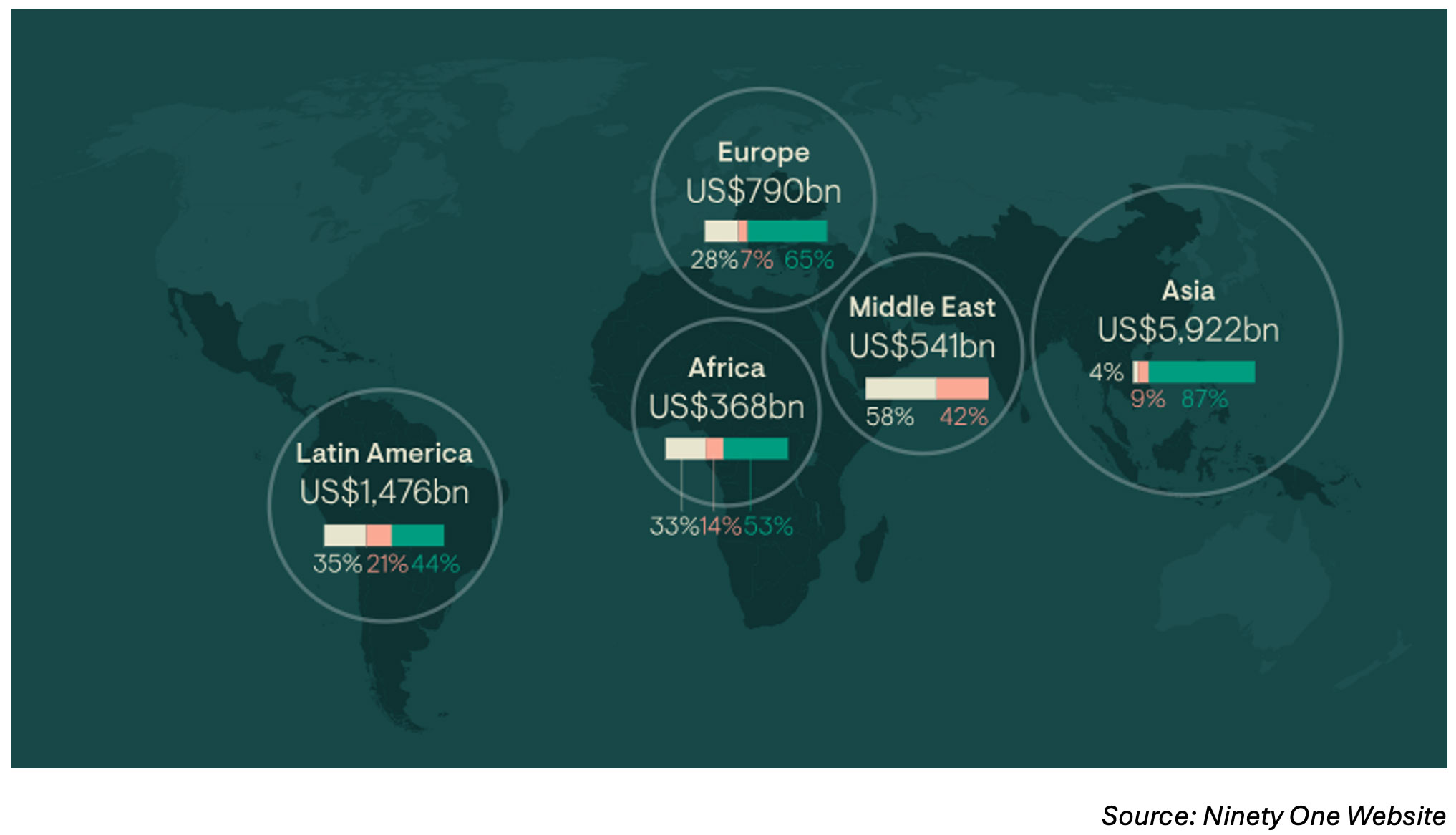
Surprisingly, EM corporate debt now exceeds US high yield and provides access to some world leading companies. The diverse asset class compares favourably to developed markets (DM); with higher yields, lower duration and less leverage than US debt for comparable credit quality.
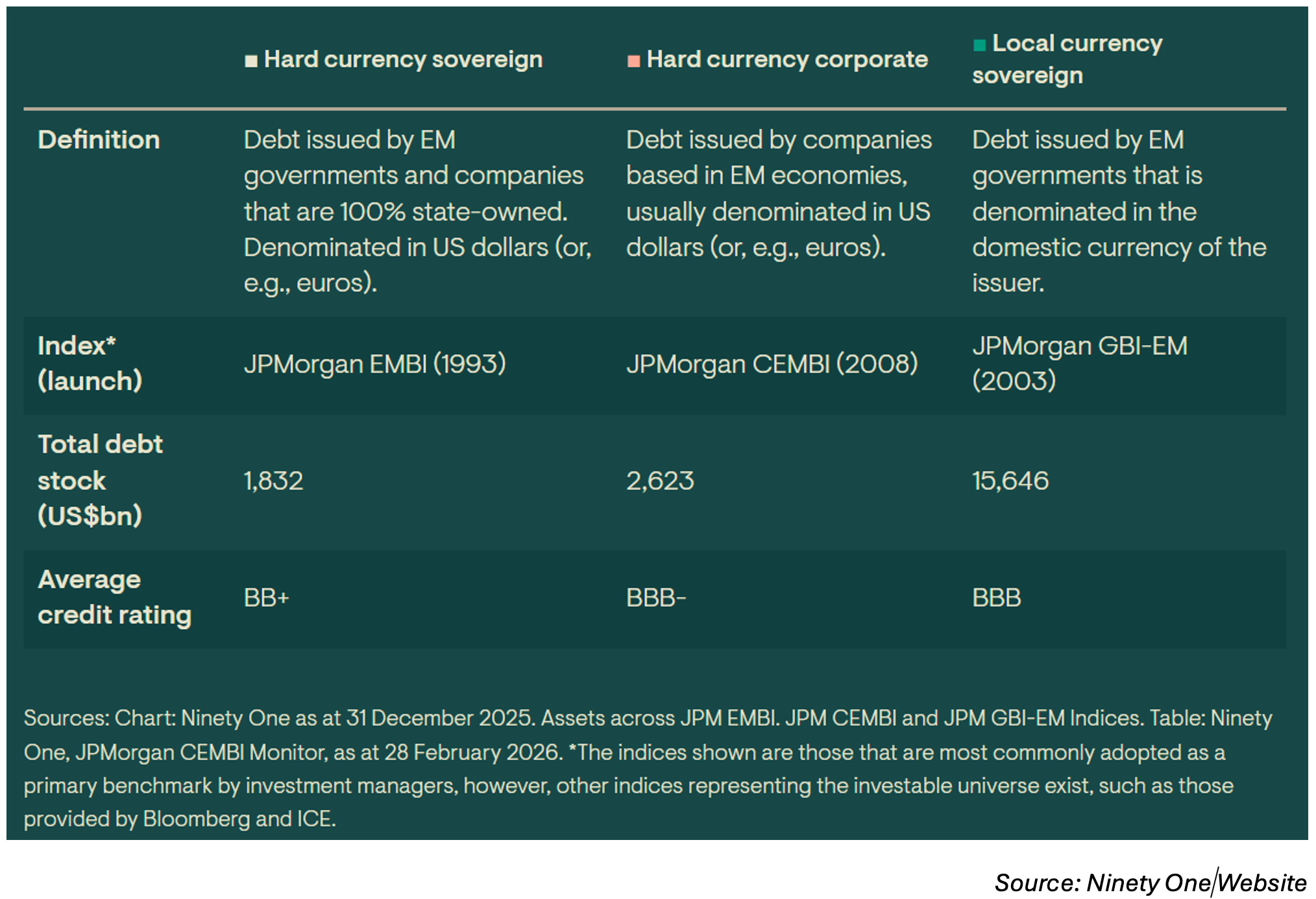
* The JPMorgan Emerging Market Bond Index (EMBI) encompasses 68 countries as at 26 February 2026.