



















Australian bond investors were badly hurt because of what they were earning and where yields started. Both are now much better, and the risk of repeating those losses is far lower.
Executive Summary
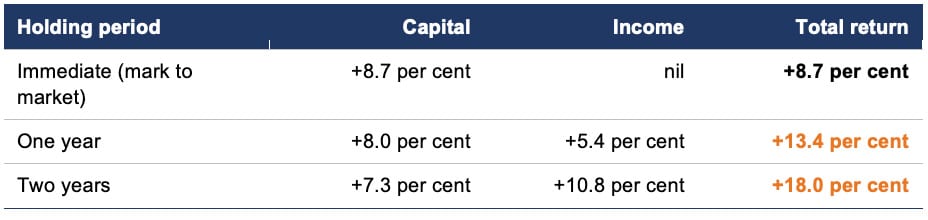
An investor who bought a ten-year Commonwealth Government Security at the low in late 2020 was down almost nineteen per cent two years later. Two things caused it, and both were features of the starting position rather than of anyone’s judgement.
First, the income they were earning was negligible. The ten-year yield was close to 1 per cent, at or near the lowest level ever recorded in Australia. One hundred basis points a year is no cushion against a move of any size.
Second, the low starting yield came with the maximum available duration. A low coupon pushes the weight of the cash flows to the back end, so modified duration at purchase was 9.49 years. The ten-year yield then rose to approximately 4.05 per cent by the end of 2022, a fourfold increase, and the price of the bond fell to 79.33.
Both of those inputs are now substantially better. A ten-year CGS today yields approximately 5.38 per cent, so the investor collects more than five times the annual income, and modified duration is 7.66 years rather than 9.49 because of the higher coupon. For the same thing to happen again, yields would have to rise very much further.
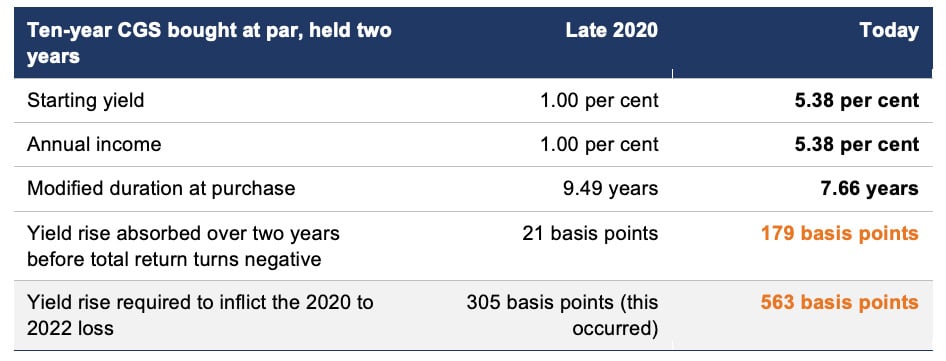
Read the last two rows together. The investor of late 2020 could withstand twenty-one basis points of yield rise across two years before losing money, and was then subjected to three hundred and five. The investor today can withstand one hundred and seventy-nine, and to suffer the same loss would need the ten-year yield to reach approximately 11.0 per cent.
Over two years today’s bond pays 10.8 per cent in cumulative income against the 2.0 per cent earned last time. Before the investor is level with the previous outcome, the bond must give back every coupon and then fall a further twenty-nine per cent in price.
Nobody is forecasting that. Nor do we forecast a rally. The point is narrower and more useful: the investor is now paid properly to hold the asset, and no longer depends on a favourable rate move to earn a return.
Long duration remains long duration, and this paper does not pretend otherwise. A ten-year holding still carries roughly seven and a half years of interest rate sensitivity, and section 3 sets out how the cushion narrows as the maturity extends to fifteen, twenty and thirty years. The improvement is real at every point on the curve. It is smallest at the very long end.
This argument holds only for an investor who buys a bond directly and can hold it. An index or a fund never matures, so it never locks in a yield. Section 5 explains why that distinction is the mechanism rather than a marketing preference.
Jim Reid of Deutsche Bank Research has made the general case for the primacy of starting yield in the Financial Times, and we recommend reading it. What follows is our test of whether it holds in the Australian market.
1. The loss, quantified
The Bloomberg AusBond Composite 0+ Yr Index, the standard measure of the Australian bond market, returned negative 2.87 per cent in calendar 2021 and negative 9.71 per cent in calendar 2022, a cumulative loss of 12.3 per cent over two years. That is the worst two-year outcome in the index’s history, and at longer maturities the individual experience was considerably worse.
Consider an investor who purchased a ten-year CGS at par in late 2020 at a yield of 1.00 per cent and marked it two years later, when the ten-year yield had reached approximately 4.05 per cent. With eight years remaining, the bond was priced at 79.33.

The income contributed two percentage points across two years against a capital loss of more than twenty. That is the position a long-dated holding puts an investor in when the starting yield is at a record low: the entire yield move must be absorbed through price, and there is almost nothing coming in to offset it.
That experience understandably left Australian investors wary of duration. But the mistake now would be assuming the same risks still apply, because both inputs have changed materially.
2. What it would take to repeat it
Apply the same exercise to a ten-year CGS purchased at par today at a yield of 5.38 per cent, held for the same two years.
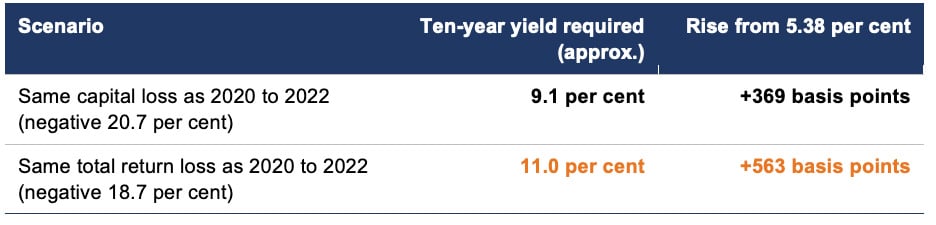
The second row is the meaningful one, because total return is what the investor actually experiences. Australia last recorded a ten-year yield above ten per cent in 1990.
The more practical test is what a range of plausible moves does, rather than the extreme required to match a historical loss. The table below applies an immediate parallel shift and holds for two years, and sets the 2020 bond alongside today’s.
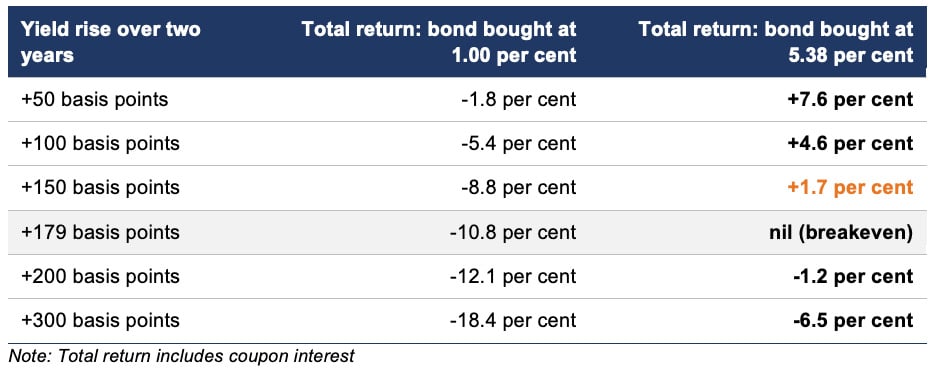
Two observations. First, a further one hundred and fifty basis points across two years, which would take the ten-year above 6.8 per cent, still leaves today’s investor marginally in front. The same shock cost the 2020 investor almost nine per cent. Second, and to be clear about it, three hundred basis points still hurts. It costs six and a half per cent today against eighteen per cent then. The improvement is substantial but it is not immunity. A 300bp move would still hurt – just nowhere near as much as it did last time.
The same test at index level gives a consistent answer. The AusBond Composite currently carries a modified duration of 4.84 and a weighted average yield to maturity of 5.19 per cent. Repeating the negative 12.3 per cent of 2021 and 2022 would require a parallel upward shift of the order of 500 basis points, against the roughly 300 basis point shift that produced the original loss.
3. Extending beyond ten years
For clients holding further out the curve, the cushion narrows as the maturity extends, because duration grows faster than yield along a curve that is only mildly upward-sloping. The table below shows how far yields can rise over two years, from current levels, before total return turns negative.
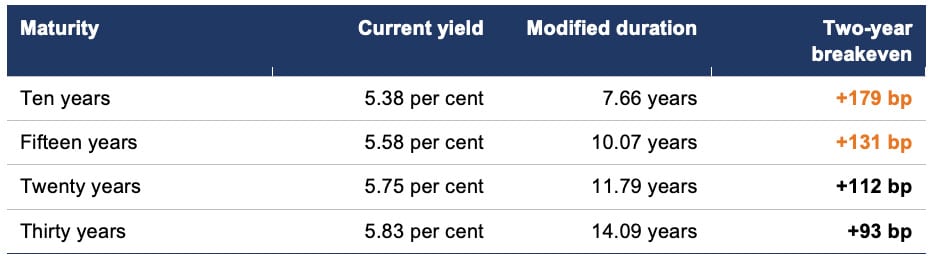
Extending from ten years to twenty buys thirty-seven basis points of additional yield in exchange for a little over four years of additional duration, and cuts the two-year cushion by more than a third. On a carry-per-unit-of-duration basis, the starting-yield argument is strongest in the ten to fifteen year part of the curve and weakest at the very long end.
This is not an argument against long-dated holdings. It is an argument that they should be held for a reason beyond the starting yield, such as matching a long-dated liability or expressing a considered view on the level of rates. The income cushion alone does not justify the extension.
Yields throughout this paper are Australian Government bond mid levels as at 14 September 2026.
4. The other side of the arithmetic
The compensation for accepting duration is that a retracement in yields now arrives on top of a substantial coupon rather than instead of one.
Assume the ten-year yield retraces to 4.30 per cent, a fall of around 110 basis points and approximately its level twelve months ago. Applied to the same bond purchased at par at 5.38 per cent:
A fifteen-year holding does better again on the same assumption. A retracement of around 110 basis points, to 4.48 per cent, would return approximately 21.9 per cent over two years. This is the trade-off in both directions: the long end gives up cushion in exchange for a larger response to a favourable move, and the investor should be clear which of the two they are buying.
We are not forecasting a retracement. The Reserve Bank has raised the cash rate three times in 2026, trimmed mean inflation is 3.6 per cent, and market pricing has recently favoured a further increase.
5. Why this only works if you own the bond
An investor who buys a specific bond and holds it to maturity receives the yield to maturity contracted at purchase, subject to the issuer paying. Interim mark to market movement is noise against a known terminal value. This is why the arithmetic above is meaningful.
At long maturities the qualification carries more weight than at five years, because few investors will genuinely hold to a twenty or thirty-year maturity. The more realistic position is that the coupon is contracted and the exit price is not. That is still a materially better position than in 2020, when neither was worth having, but it should be stated rather than glossed.
An investor in a bond index or an index fund receives no such contract at all. The portfolio rolls perpetually, holdings are replaced before maturity, and there is no date at which the purchase yield is realised. The gap is visible in the AusBond Composite today: a weighted average yield to maturity of 5.19 per cent against a weighted average coupon of 3.31 per cent and a running yield of 3.65 per cent, the legacy of the 2020 and 2021 issuance vintages still sitting inside the benchmark.
The difference between those figures is accretion, and it is genuine return. But it accrues through price convergence rather than cash, and it is only realised if the individual securities are held to maturity, which in an index they are not.
For wholesale investors with defined liabilities or income requirements, this distinction matters. The improvement in the return profile is available in full to the direct holder. It is available only in attenuated and uncertain form to the index holder.
6. What this argument does not claim
We would put four qualifications on the analysis above, and we would put them to clients directly.
● Duration risk has been reduced, not removed. A ten-year holding still loses six and a half per cent on a three hundred basis point move over two years, and a thirty-year holding loses considerably more. The tables above are the relevant disclosure, not the headline breakeven.
● Yields are not bounded. A 369 basis point rise is improbable. It is not impossible, and Australia has recorded double-digit long yields within living memory.
● The arithmetic is nominal. With trimmed mean inflation at 3.6 per cent, a 5.38 per cent nominal yield is a real yield of approximately 1.8 per cent. That is positive, which it was not for most of the last decade, but it is thin, and a renewed inflation shock damages the real outcome even where the nominal outcome is absorbed.
● Interim losses remain real for anyone who may need to sell. Hold-to-maturity is a strategy, not an accounting exemption, and at long maturities it is often not a realistic one. Investors who mark to market, or who may face liquidity calls, carry the full volatility set out in section 2.
In closing
The loss of 2020 to 2022 was arithmetic rather than misjudgement. The investor was earning one per cent, from a starting yield that had never been lower, on a bond carrying the maximum duration available at that maturity. A move of three hundred basis points took nearly nineteen per cent off the value of the holding.
None of those conditions holds today. The ten-year pays 5.38 per cent, duration at purchase is 7.66 years rather than 9.49, the two-year cushion has gone from twenty-one basis points to one hundred and seventy-nine, and matching the previous outcome would require a yield near eleven per cent.
The cushion narrows as the maturity extends, and at twenty and thirty years it is thinner than many holders assume. Long-dated positions should be taken for a reason, and the reason should be a liability to match or a view to express, with the improved starting yield as support rather than as the case in itself.
Income, rather than capital appreciation, is doing the work again. For the investor who owns the bond rather than an index of bonds, that is the whole point.