














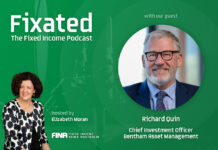




For a long time, bonds were treated as ballast in a portfolio. Something you held out of caution rather than conviction. That has changed, especially for those in retirement, according to Bentham Asset Management, a specialist fixed interest and credit investment manager.
“Investors can now earn an attractive yield relative to other assets, following a long period of near zero interest rates after the GFC and COVID. At 5.25%, high quality government bonds are cheap and are at levels that can provide meaningful income without requiring investors to take on significant risk. They can provide the same if not better yields than equity dividends without the high capital risk of equities,” says Richard Quin, chief investment officer, Bentham Asset Management.
“Bonds can therefore play a much more productive role, providing income today and the potential to help offset weakness elsewhere in a portfolio, should equities continue to sell off,” he adds.
Through fixed income investors can lock in attractive income today from high quality securities, without depending on the economic growth or risk taking that other asset classes require. At the same time, if growth slows or interest rates move lower, bond investors have the potential to benefit from capital appreciation as well as income.
“For years, investors felt they had to move up the risk spectrum to generate income. Today, they don’t. That’s what makes the opportunity to invest in bonds so strong today,” notes Quin.
“Our view is that interest rates are close to their peak. Recent inflation pressure has been driven by supply-side factors, including energy, which central banks cannot directly control. At the same time, rates are already restrictive, and housing and the broader economy are slowing meaningfully.
“So the key question is not whether there could be one final move higher in rates. It is whether investors should use today’s yields to lock in income before the cycle eventually turns,” he says.
Historically, some of the strongest returns for fixed income have begun when investors locked in yields around the peak of a tightening cycle. No one can identify that peak precisely, but current yields give investors a solid buffer against inflation while they wait.
“When we look around the world, Australia remains one of the fixed interest markets we find most attractive. It is a high-quality, AAA-rated sovereign issuer with comparatively manageable public debt (as a percentage of GDP, compared to the rest of the world), a strong independent reserve bank, and government bond yields that offer investors an attractive level of income above the RBA’s inflation target,” notes Quin.
Also read: Market Correction Puts Fixed Income Back In the Spotlight
Bentham actively rotates between markets rather than treating fixed income as a single, static exposure.
“Long duration fixed interest is one of the areas we find particularly attractive at the moment,” says Quin.
“What is interesting about the current environment is the balance of outcomes. If yields stay around current levels, investors continue earning attractive income. If growth slows, energy related inflation pressure fades, or central banks eventually ease policy, longer dated bonds can also provide capital appreciation and portfolio protection. So while mark-to-market volatility is always part of investing, investors are now being compensated much more effectively for taking that risk,” he adds.
Currently credit spreads remain tight relative to history. In simple terms, a credit spread is the extra yield investors earn for lending or taking credit risk.
“We avoid stretching for yield or spread where the risk doesn’t adequately compensate our investors. Risks appear elevated given the uncertainty around growth, geopolitics, refinancing costs and the capital required for areas such as the AI build-out.
“Currently, we are selective, with a higher quality bias and retained liquidity. Keeping liquidity available gives us and our investors the flexibility to invest in credit when spreads widen and more attractive opportunities emerge. We are positioned to take advantage of those opportunities,” he notes.
“The key point is that investors don’t need to choose between fixed interest and credit investments. As an active manager, we make that choice for the investor, and we have done so successfully for over 20 years.
“The best diversified fixed income portfolios draw on a range of different return drivers. That means holding fixed income when government bonds offer attractive yields and provide defensive potential. In credit, it means holding quality, liquid credit where investors are adequately compensated for risk. And equally, it means taking advantage of riskier credit when it overcompensates investors for the risk.
“Ultimately, the goal is to generate attractive risk-adjusted returns across different market environments,” notes Quin.