



















Thomas Poullaouec, Head of Global Investment Solutions, International and Portfolio Manager at T. Rowe Price, and his team have published their latest insights on global asset allocation and the investment environment for Australia. August 2026.
OUTLOOK
Markets have continued to demonstrate resilience, supported by stronger-than-expected corporate earnings and sustained AI-related investment, although geopolitical developments have contributed to volatility.
The global economy remains supported by fiscal spending and technology investment, though growth is becoming more uneven across regions as higher energy costs and geopolitical uncertainty weigh differently across economies.
Despite receding risks of an energy supply shock, tight monetary policy, housing market challenges, and signs of weakening activity creates a challenging domestic environment and raises uncertainty around growth and earnings.
The policy outlook remains highly data dependent as central banks continue to balance persistent inflation pressures, particularly those related to energy, with continued signs of stable economic growth.
Key risks include renewed geopolitical escalation and commodity price volatility, persistent inflation, continued reliance on a narrow set of market leaders, and signs of deterioration in labor markets.
From AI Spark to Earnings Fire
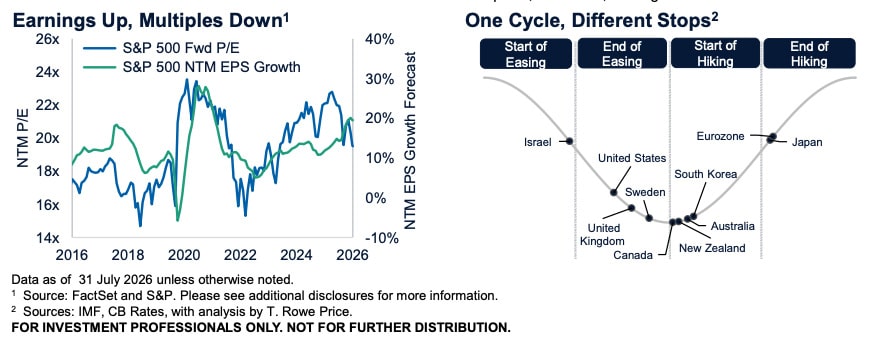
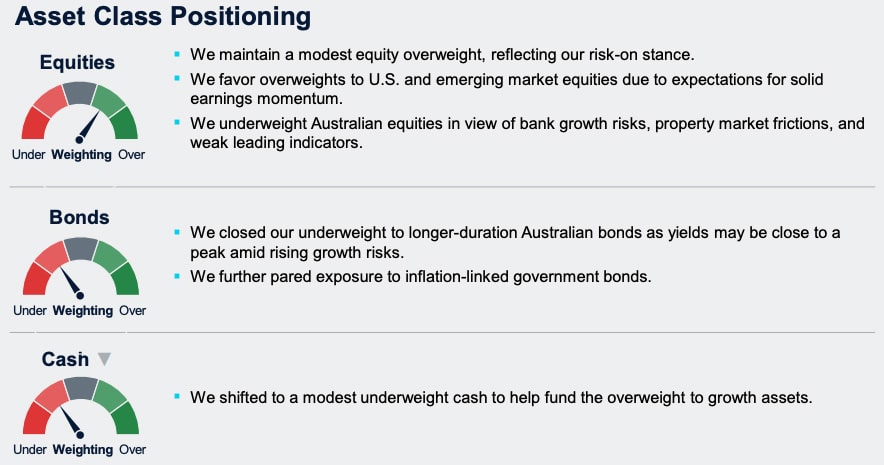
We recently moved modestly overweight stocks versus bonds, reflecting confidence in the durability of earnings rather than a broad risk-on view. Economic growth has remained resilient despite geopolitical disruptions, higher energy costs, and tighter financial conditions, reducing the risk of a near-term earnings downturn. More importantly, earnings momentum is broadening beyond the largest technology companies, with more sectors reporting stronger orders, improving margins, and upward revisions to guidance. AI-related investment is also extending into power, data centers, industrial equipment, automation, and connectivity, supporting a broader private-sector capital spending cycle as fiscal support fades. Disinflation provides an important secondary tailwind. Softer inflation reduces the likelihood of further Fed tightening, creating a more supportive environment for stocks. At the same time, long-duration bonds remain exposed to heavy issuance, persistent fiscal deficits, and resilient nominal growth. With corporate balance sheets healthy, capital markets open, and investor positioning not excessively bullish, we believe equities offer a better balance of upside participation and relative risk.
Also read: Growth Remains Resilient, But The Bond Outlook Is Getting Tougher
Hiking, Holding, Cutting
The global policy cycle is becoming increasingly fragmented as central banks respond to different combinations of growth and inflation conditions, fiscal policies, and government measures to cushion energy shocks. In the U.S., softer inflation supports the case for the Federal Reserve to remain on hold, but resilient growth, AI-related investment, and continued fiscal support argue against a rapid shift toward easing. That leaves the Fed caught between upside and downside risks, with policy uncertainty likely to keep interest-rate volatility elevated. Elsewhere, policy paths are more distinct as central banks face different trade-offs. The European Central Bank may face renewed tightening pressure as higher energy costs combine with German fiscal expansion and resilient growth in parts of the euro area, including Spain and Italy. Australia and the U.K. may stay on hold as softer growth offsets lingering inflation pressures. Japan could still need to raise rates as temporary subsidy-driven relief masks underlying inflation pressures, while China may remain comparatively dovish given ongoing growth concerns. For investors, varying inflation trends and domestic growth conditions are likely to drive greater divergence across policy-rate paths, currencies, and regional markets.
ASSET CLASS POSITIONING
Note: T. Rowe Price’s Australia Investment Committee comprises local and global investment professionals who apply views from the firm’s Global Asset Allocation Committee to make informed asset allocation views from an Australian investor perspective. The Committee is led by Thomas Poullaouec, Head of Multi-Asset Solutions APAC, based in Singapore.