


















Thomas Poullaouec, Head of Global Investment Solutions, International and Portfolio Manager at T. Rowe Price, and his team have published their latest insights on global asset allocation and the investment environment for Australia. September 2026.
OUTLOOK
Markets have remained resilient, supported by strong and broadening corporate earnings and sustained AI-related investment,
although elevated valuations and geopolitical uncertainty remain sources of volatility.
The global economy remains supported by technology investment and fiscal spending, though growth is increasingly uneven
across regions as higher energy costs, interest rates, and geopolitical uncertainty create divergent pressures.
Australia still faces headwinds from slowing domestic growth, housing market challenges, a meaningful supply shock from higher
energy prices and tighter monetary policy, but higher commodity prices could provide upside potential for the mining sector.
The policy outlook remains highly data dependent as central banks balance persistent inflation pressures against resilient
growth, while fiscal concerns and strong investment demand are contributing to upward pressure on longer-term yields.
Key risks include renewed geopolitical escalation and commodity price volatility, persistent inflation and higher interest rates,
earnings sustainability, and signs of deterioration in labor markets.
A Broader Earnings Engine
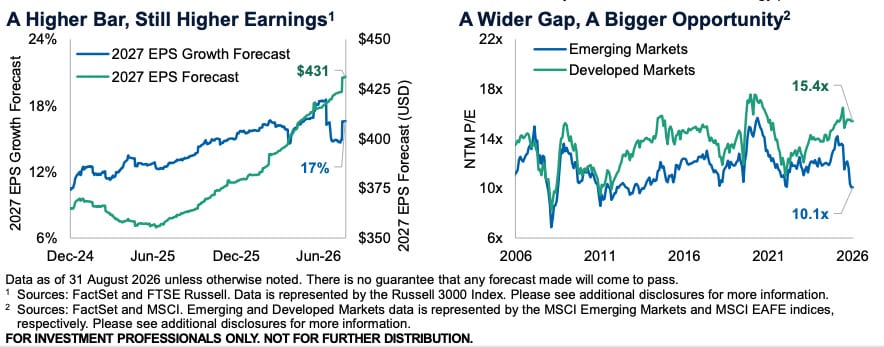
The latest earnings season provided compelling evidence that the profit cycle is broadening. Results were strong across the market, with roughly 78% of S&P 500 companies beating earnings estimates and positive revisions spreading across industries. Those beats are lifting 2026 earnings expectations, yet 2027 estimates continue to rise and still imply robust growth—an encouraging sign that earnings momentum is strengthening even off a higher base. Recent market behavior offers another encouraging signal. Despite a de-rating in parts of the AI complex, broader markets proved resilient as strength elsewhere helped pick up the slack. AI remains an important earnings driver, with hyperscaler results reinforcing the investment runway, but it no longer needs to carry the market alone. Robust M&A and healthy capital markets provide additional support. This increasingly diversified earnings backdrop reinforces our constructive view on equities, while elevated valuations and expectations argue for selectivity and disciplined positioning.
Also read: Look What You Made Me Downgrade – State Debt
Emerging Markets’ Next Act
We recently increased our overweight to emerging market (EM) equities as improving fundamentals converge with compelling valuations. Following the recent sell-off, some froth has come out of EM markets, while earnings remain supportive. At roughly 10x forward earnings versus more than 15x for developed markets, EM offers an increasingly attractive entry point. Importantly, the opportunity is extending beyond the technology story we previously highlighted. Broader capital spending on infrastructure, manufacturing, energy security and digital capacity is creating new sources of growth, while AI infrastructure remains an important tailwind in Taiwan and Korea. A weaker U.S. dollar could provide another boost by easing financial conditions and supporting capital flows, with persistent U.S. fiscal deficits reinforcing our expectation for intermediate-term dollar weakness. Together, solid earnings, expanding investment and attractive valuations provide a more diversified foundation for EM returns, supporting our overweight while remaining mindful of technology concentration, cyclical risks and elevated energy prices.
ASSET CLASS POSITIONING
Note: T. Rowe Price’s Australia Investment Committee comprises local and global investment professionals who apply views from the firm’s Global Asset Allocation Committee to make informed asset allocation views from an Australian investor perspective. The Committee is led by Thomas Poullaouec, Head of Multi-Asset Solutions APAC, based in Singapore.