



















Real yields near post-GFC highs, set against forecasts of negative productivity growth.
From Chamath De Silva, Head of Fixed Income at Betashares
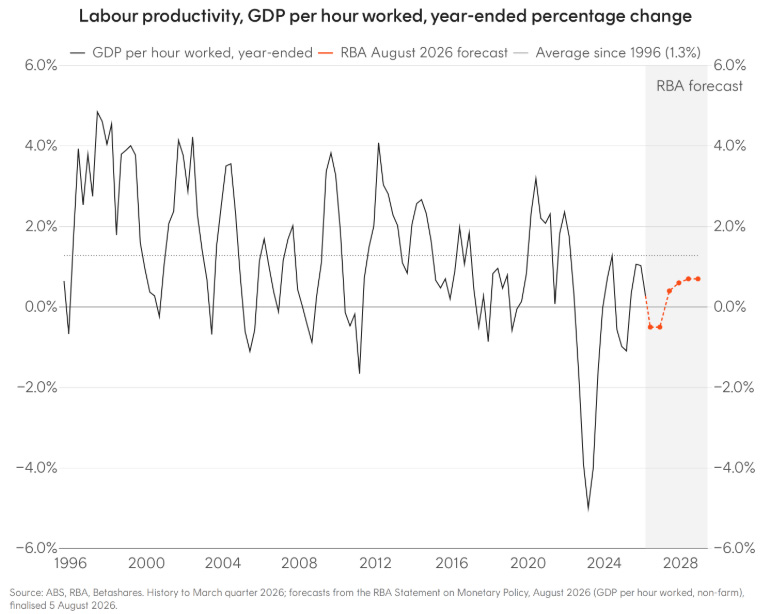
Australia’s productivity problem has been an area of debate for some time, but it’s now in the official forecasts. In the August Statement on Monetary Policy, the RBA revised its labour productivity forecasts (defined as real GDP per hours worked) to minus 0.5 per cent through 2026, with only a modest recovery to an assumed trend of 0.7 per cent by 2028. This is significantly lower than the 30-year average of 1.3%. The Bank itself concedes there is little evidence of a sustained improvement to date, listing subdued productivity as a key risk to the outlook.
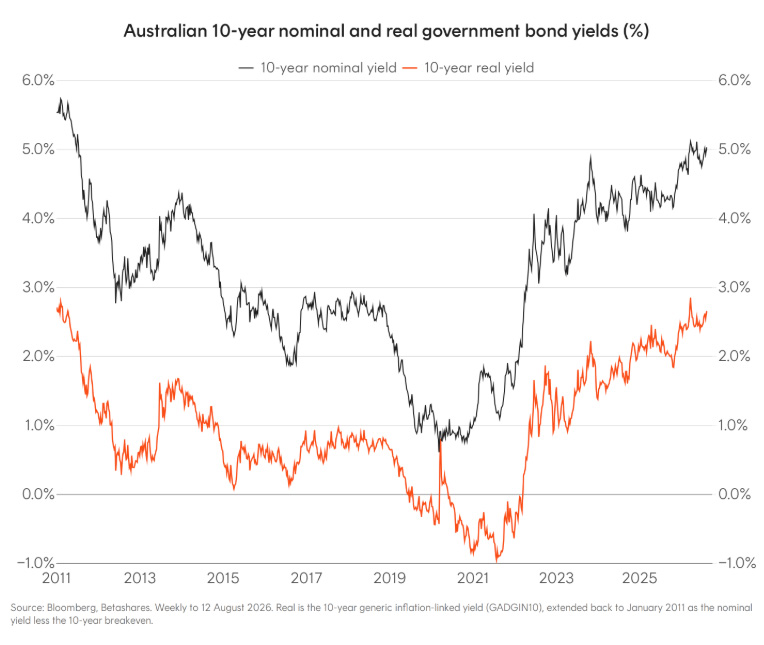
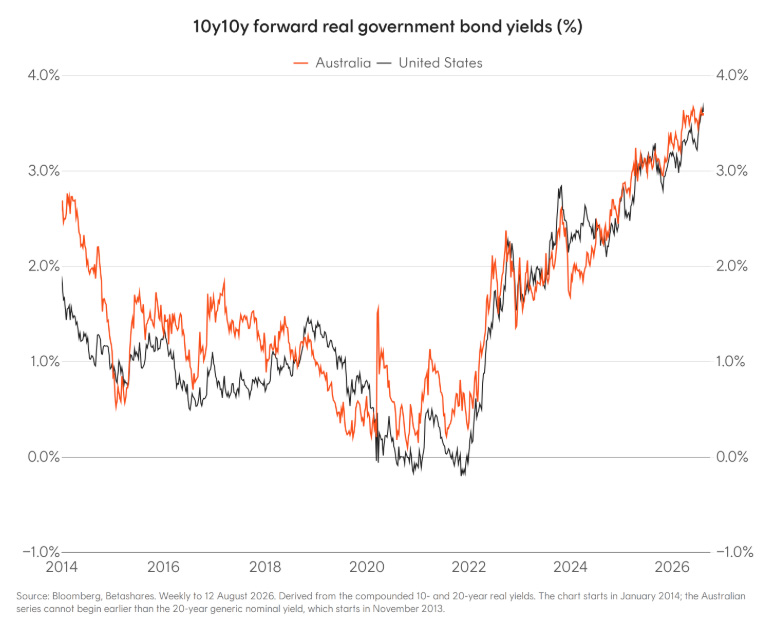
Set against this, the bond market is telling a very different story. The 10-year Commonwealth government yield sits above 5 per cent, and the 10-year real yield at 2.65 per cent, close to its highest level since the GFC era. While inflation has been sticky of late, it’s not about inflation expectations, which remain well anchored. Forward real yields are even more striking, sitting above 3 per cent. On its face, the market is pricing an economy capable of generating real economic growth that’s at odds with what we’re seeing in the data.
What’s driving long-term bond yields?
Long-term yields reflect several components, including expected policy rates over the short-to-medium term, longer-run growth and inflation expectations (which anchor estimates of the neutral rate), and a term premium compensating investors for bearing duration risk. But over the long run, real yields should broadly gravitate towards the economy’s potential growth rate, itself a function of productivity and population growth. With productivity flat to negative, the fundamental anchor for Australian real yields looks well below where the market currently sits.
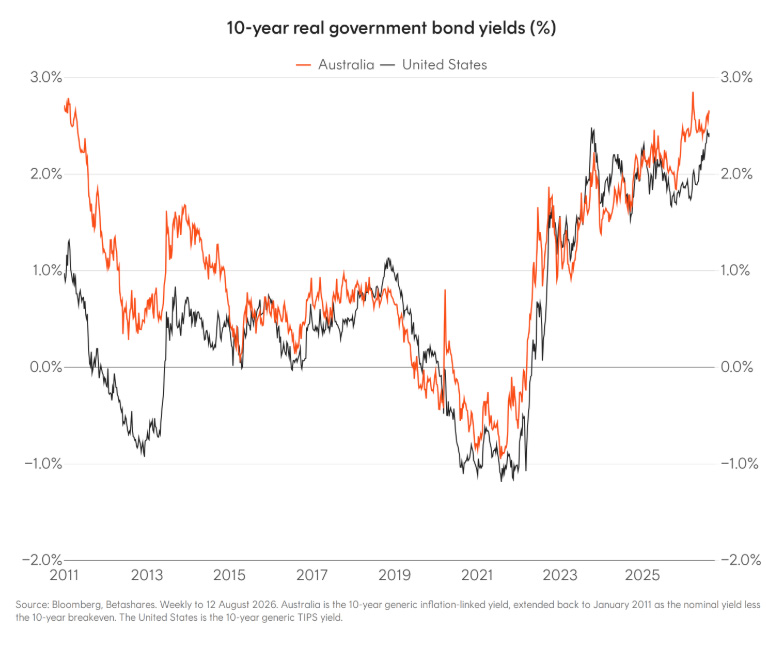
Part of the answer is that Australian bonds don’t exist in domestic vacuum. Real yields have risen across developed markets globally, plausibly reflecting a US-led surge in AI-related capex that has lifted the demand for capital worldwide. Economic theory tells us that real yields are set by what clears investment against savings globally, not necessarily by the return on capital in each economy. But this is where Australia’s position becomes uncomfortable. We import the higher cost of capital without importing the investment boom that justifies it. Our own data centre build-out, while growing, pales next to what’s happening in the US, and much of our spending leaks into imported IT equipment anyway. For the rest of the economy (households, housing, non-tech businesses), globally elevated real yields simply represent tighter financial conditions and a crowding-out effect, with no offsetting productivity dividend.
High bond yields are self-correcting
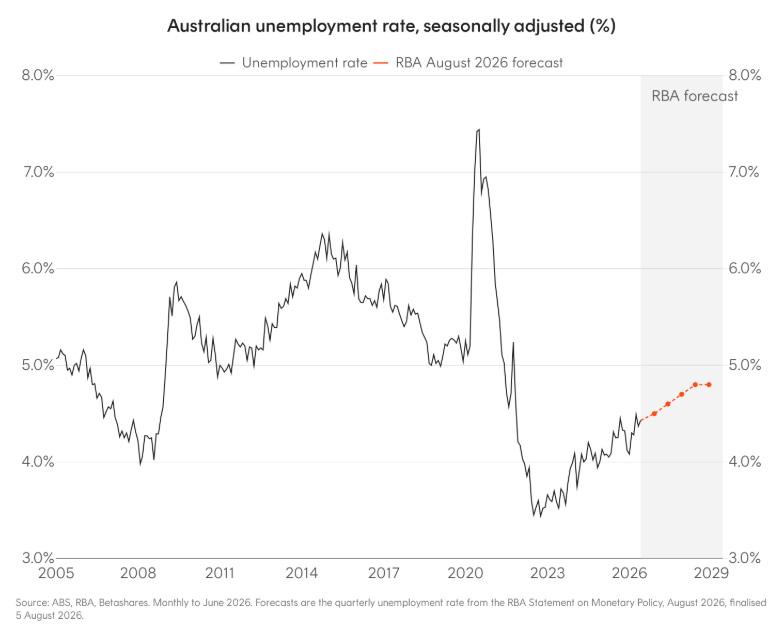
Bonds yields are self-correcting and returns on bonds tend to mean revert. Weak productivity means weak real income growth, a softer consumer, and a labour market already forecast to loosen, with the RBA projecting unemployment rising to 4.8 per cent by end-2028. Tighter financial conditions accelerate that process. Slack builds, inflation pressures fade, and the RBA is eventually forced into an easing cycle that drags both real and nominal yields lower.
There’s a scenario where the productivity dividend does arrive. If AI adoption delivers the anticipated boost, real yields might settle higher than the depressed levels of the 2010s, but well-anchored inflation and reduced macro uncertainty would compress the term premium, pulling nominal yields lower and supporting bond returns.
If you’re bearish on the Australian economy and sceptical the productivity dividend arrives, the consistent position is to be bullish on bonds at current yields. And if the optimists are right, disinflation and a lower term premium do the work instead. Today’s starting yields offer compensation for waiting and capital upside across a wide range of outcomes.