

















Summits among big countries get a lot of attention, but they have generally been all about show rather than substance.
There was much attention on the recent summit between US and China. While it may not have been “the biggest summit ever” as Trump has said, there was greater importance placed on this summit given that it was occurring in the backdrop of the Iran war and the trade war.
Once again, this summit was big on optics but gave little in the way of detail.
So not really too many surprises as far as summits go, but disappointing when markets were maybe hoping for something more tangible on China involvement in Iran or trade promises.
The thing is, when it comes to Iran, China and the US should in theory be aligned. Instability in the region and having Iran hold the Strait of Hormuz hostage is not in China’s best interests.
We did receive a vague agreement that the Strait of Hormuz should be re-opened and China’s foreign ministry spoke out against military action. It’s also possible that China will work behind the scenes and talk to Iran in softening its stance against the US.
But China has had a longstanding policy of non-interference when it comes to foreign affairs, with the ideology going back to the beginnings of the Chinese Communist Party. And the idea that China would not interfere in another country’s domestic policies has in a way worked for China when building trading alliances with the Global South.
However, increasingly an argument is being made among analysts that China should shift from this policy of non-interference to further China’s foreign interests. It makes sense – as China’s economy has become bigger and more globally integrated, China’s interests are increasingly being affected by what happens abroad.
Xi sees China as ideologically different to the US and past imperial powers and non-interference as part of that. Its way of saying that China’s way of how it deals with global governance is morally superior. Not only that, Xi also sees ideology as fundamental in keeping the CCP in power.
So, this change to further China’s interests? It’s possible, but in the past, China has not changed how it does things, just because a bunch of experts say it’s a good idea. Economists have been saying for decades that reliance on investment and production was not sustainable, and that China needed to boost domestic demand. While there is growing recognition in official rhetoric that the old economic growth model was no longer working, there hasn’t been much of a meaningful shift away from it.
This brings us to the other contentious issue between China and the US – trade.
Trump can make all the deals he wants with China to buy Boeing aircraft, soybeans and beef. But while China’s policies continue to prioritise supporting industry and production over households and consumption, domestic demand is likely to lag behind production. That means China will still likely maintain its massive surplus with the rest of the world.
Increasingly, it is not just the US that is unhappy with China’s trading relationship, but Europe as well. China’s trade gap with Europe has steadily widened in the past few years.
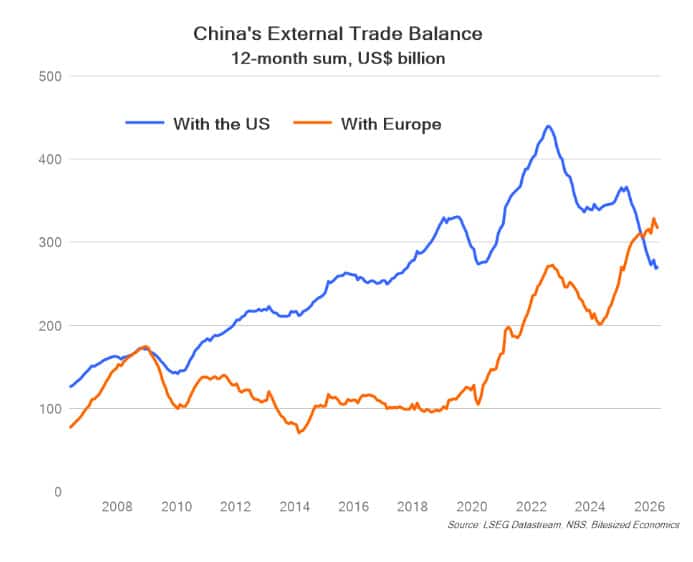
With EU leaders increasingly talking tough on its trade imbalance with China, the Euro zone is now looking to implement its own industrial policy. Dubbed the Industrial Accelerator Act (IAA), the aim is to boost EU industrial manufacturing to 20% of GDP by 2035 (currently at 14%) and support “made in EU”. Sound familiar? No one wants to be the consumer of last resort anymore, and that includes China.
China has had immense success with its model of growth, through supporting its industrial sector. But how China has done things in the past is running into major hurdles and now potentially contradicting long-term economic interests. It would be Chinese households that benefit from gaining a bigger income share of the economy. But for whatever political interests that are present, and probably a belief among some officials that what worked in the past will continue to do so in the future, it’s been difficult to fundamentally change China’s growth model.
The same could be said with China’s longstanding “non-interference” foreign policy stance. China may agree that the Strait of Hormuz should be open and that the war should end. But while as much as China may want de-escalation, it would be a major shift in strategy to see China going further than diplomatic means. China will probably still support Iran economically by buying its oil. China will still probably ignore US sanctions. China is unlikely to get involved militarily. Whether that’s enough to influence Iran, well, we shall see.